

15 Sep - 01 Oct
9:30 am – 12:00 pm (EDT)
2.5 hrs - Tue, Wed, Thu: 9 sessions
Virtual
$ 1099
17 Oct - 01 Nov
8:30 am – 12:00 pm (EDT)
3.5 hrs - Sat, Sun: 6 sessions
Virtual
$ 1099
No prior AI, technical, or project management experience is required.
Complete the PMI-CPMAI Exam Prep Course — this is mandatory before scheduling the exam.
After course completion, schedule your exam through your myPMI account.
Take the exam at a Pearson VUE test centre or online with remote proctoring.
The exam has 120 questions with 160 minutes of testing time.
Successfully complete the exam to earn the PMI-CPMAI™ certification.
Evaluate AI opportunities and determine whether AI is the right solution to a business problem.
Build the logic for an AI business case, ROI, scope, resources, success measures, and go/no-go decisions.
Define and assess data needs, readiness, quality, privacy, and preparation requirements.
Coordinate AI/ML model development and challenge technical choices without needing to be the data scientist.
Evaluate solutions using both business outcomes and model-performance metrics.
Plan deployment, monitoring, governance, transition, and continuous improvement of AI solutions.
Apply responsible and trustworthy AI practices throughout the lifecycle.
Prepare for the certification exam through scenario-based practice and full-length mocks.
PMI-CPMAI is more than an exam syllabus. The course develops the competencies required to manage AI, machine learning and generative AI projects from business idea through operationalization.
The learning journey consists of seven modules. Module 1 establishes the foundations of AI project management, while Modules 2–7 take you through the six phases of the CPMAI methodology—Business Understanding, Data Understanding, Data Preparation, Model Development, Model Evaluation and Operationalization.
Understand why AI projects need a different management approach.
Turn a business problem into a credible AI opportunity.
Determine whether you have the right data to make the AI solution work.
Transform raw data into reliable, governed and model-ready data.
Manage AI model development without needing to become the data scientist.
Determine whether the AI solution is reliable, valuable and ready for deployment.
Move AI from experimentation into real-world operation and sustain its value.
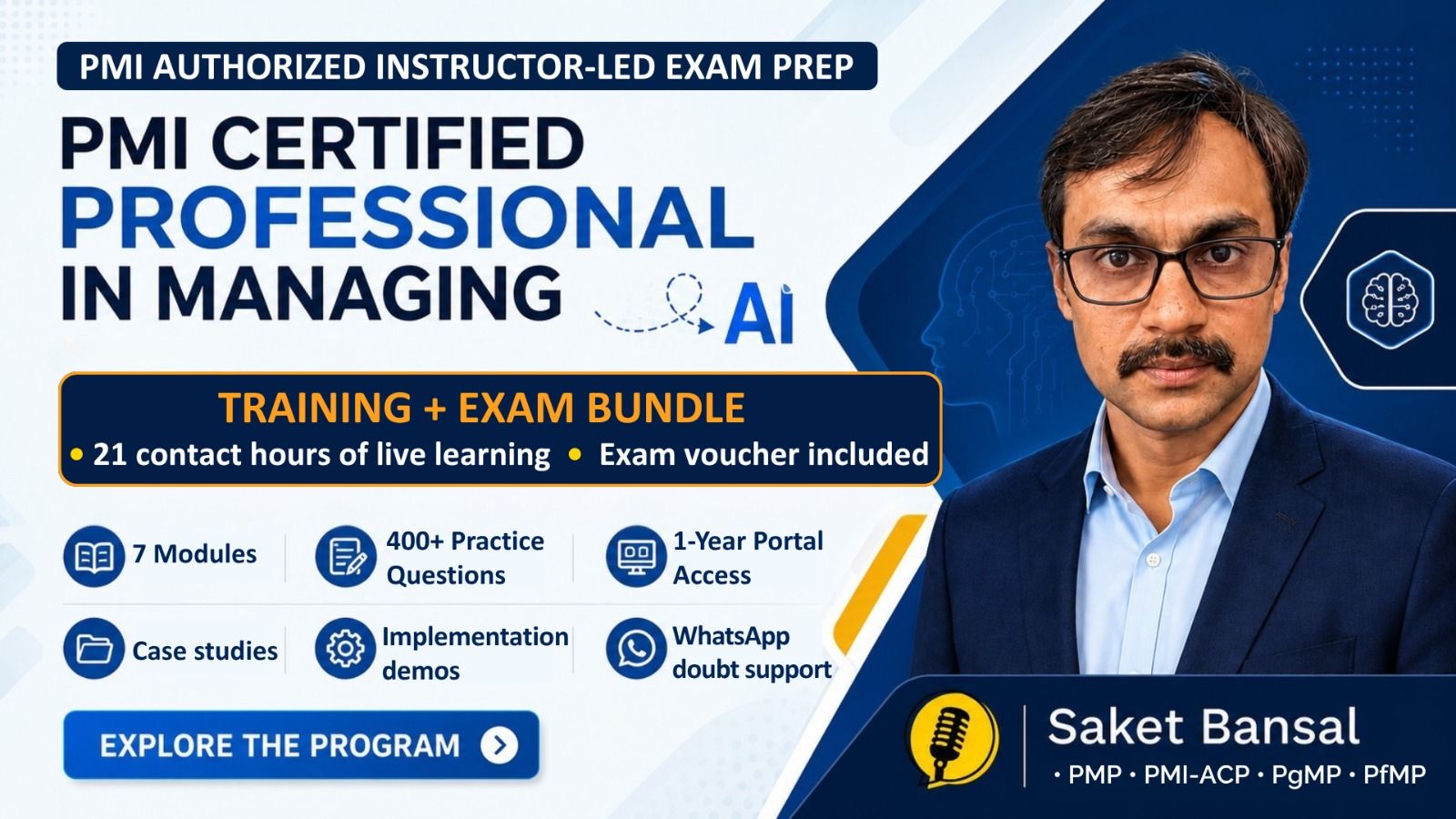
The displayed price is for the PMI-CPMAI Training + Exam Bundle and includes both official PMI components and iZenBridge learning support. The bundle includes the PMI-CPMAI exam voucher and official course materials, 21 contact hours of live iZenBridge training, one-year learning portal access, 400+ practice and mock questions, case-study resources, implementation demonstration videos, and WhatsApp doubt support.
Important: PMI uses region-specific pricing and exam vouchers. The bundle price therefore depends on the country/region from which you will take the exam. Please confirm your applicable region before purchasing. An exam voucher issued for one PMI pricing region may not be valid for use in another region.
Applicable taxes, where required, are charged separately.
Please talk to us before enrolling. You should not pay for a duplicate exam voucher. We can review what your PMI purchase already includes and discuss a customized solution for live training, mentoring, practice questions, case studies or portal support, subject to availability and PMI eligibility rules.
The standard iZenBridge PMI-CPMAI program includes 21 contact hours of live, instructor-led training, supported by one-year access to the iZenBridge learning portal for revision, practice questions, case studies, videos, and other learning resources. PMI requires completion of the PMI-CPMAI Exam Prep Course before a learner can schedule and take the certification exam.
If you have already completed the required PMI-CPMAI training through PMI or another eligible training route and do not need the full live program again, please contact us. We can explore a custom self-paced learning and exam-preparation option focused on areas such as concept reinforcement, case studies, mock exams, and revision.
The PMI-CPMAI Exam Prep Course must be completed before the exam can be scheduled. iZenBridge should state its PMI Authorized Training Partner delivery status clearly and explain the course-completion and voucher process for the selected batch.
You receive one year of access to the iZenBridge learning portal for the PMI-CPMAI resources included with your enrolment, including applicable recordings, practice questions, case studies, videos, and revision resources.
The PMI certification timeline is also time-bound. PMI states that you have one year (12 months) from the time of purchase to obtain the PMI-CPMAI certification.
This means you should plan to complete the training, schedule your exam, and take the certification exam within the applicable one-year period rather than leaving the exam until much later.
We recommend starting your exam preparation soon after the live training so you have sufficient time for revision.
The preparation package includes 400+ practice and mock questions. Explain that these are distributed across knowledge checks, domain-focused tests and full-length mock practice, with answer explanations where available.
Yes. The official PMI learning material itself uses cross-phase case studies to show how the CPMAI methodology is applied from business understanding through data, model development, evaluation, and operationalization. Examples include an IT Help Desk AI Assistant, Internal Policy Generative AI Solution, and Insurance Claim Fraud Detection.
On top of these PMI examples, iZenBridge provides deeper practical case studies designed to help you apply the concepts more realistically. We go further into areas such as ROI and cost calculations, solution choices, data requirements, model and infrastructure decisions, testing, governance, and operational considerations.
You also receive case-study videos and supporting documents, helping you connect individual concepts into a complete AI-project decision flow rather than learning each topic in isolation.
Yes. The PMI-CPMAI program is designed for professionals managing AI initiatives, not for turning learners into software developers or data scientists. Its official content focuses on understanding and managing areas such as data, model development, evaluation, deployment, governance, and operationalization.
At iZenBridge, we go a step further by providing technical implementation demonstrations in our tutorials and case-study sections. You can see how concepts discussed in the methodology translate into working AI solution components.
For example, we demonstrate model training, API-based AI implementations, solution architecture, and deployment-related choices, and in selected tutorials we also provide sample code that you can run yourself to better understand what happens behind the scenes.
These demonstrations are designed to make you a more informed AI project leader who can engage confidently with technical teams. They are implementation walkthroughs—not a full coding or data-science bootcamp unless specifically stated in the batch description.
No. You do not need prior AI, data-science, coding, or AI-certification experience to take the PMI-CPMAI program.
The course is designed for professionals who want to lead or contribute to AI and machine-learning initiatives, rather than become data scientists. Familiarity with project, program, product, business, or technology environments can be helpful, but it is not a technical prerequisite.
You will build enough understanding of AI concepts, data, models, testing, governance, and operationalization to make informed project decisions and work effectively with technical specialists.
Learning support continues beyond the live sessions. Enrolled learners receive access to an iZenBridge WhatsApp doubt-clarification group, where they can raise questions while studying, revising, or working through practice questions and case studies.
You can also use iZenBridge learner support for program-related assistance.
This gives you a way to clarify concepts after class instead of depending only on the scheduled instructor-led sessions. Any batch-specific support period or service conditions will be communicated as part of your enrolment.
No. PMI membership is not included in the Training + Exam Bundle price.
The bundle covers the components specifically listed on this page, including the PMI-CPMAI course and exam components and iZenBridge training and learning support.
If you would also like to become a PMI member, the membership must be purchased separately from PMI.


Write a Review
You must be logged in to post a comment.