
07 May - 08 May

  • 9:00 am – 12:30 pm (EDT)

    3.5 hrs - Thu, Fri: 2 sessions

  • Thu-07-May
    Fri-08-May
  • Virtual

  • $ 99

  • $

Upcoming trainings

Overview

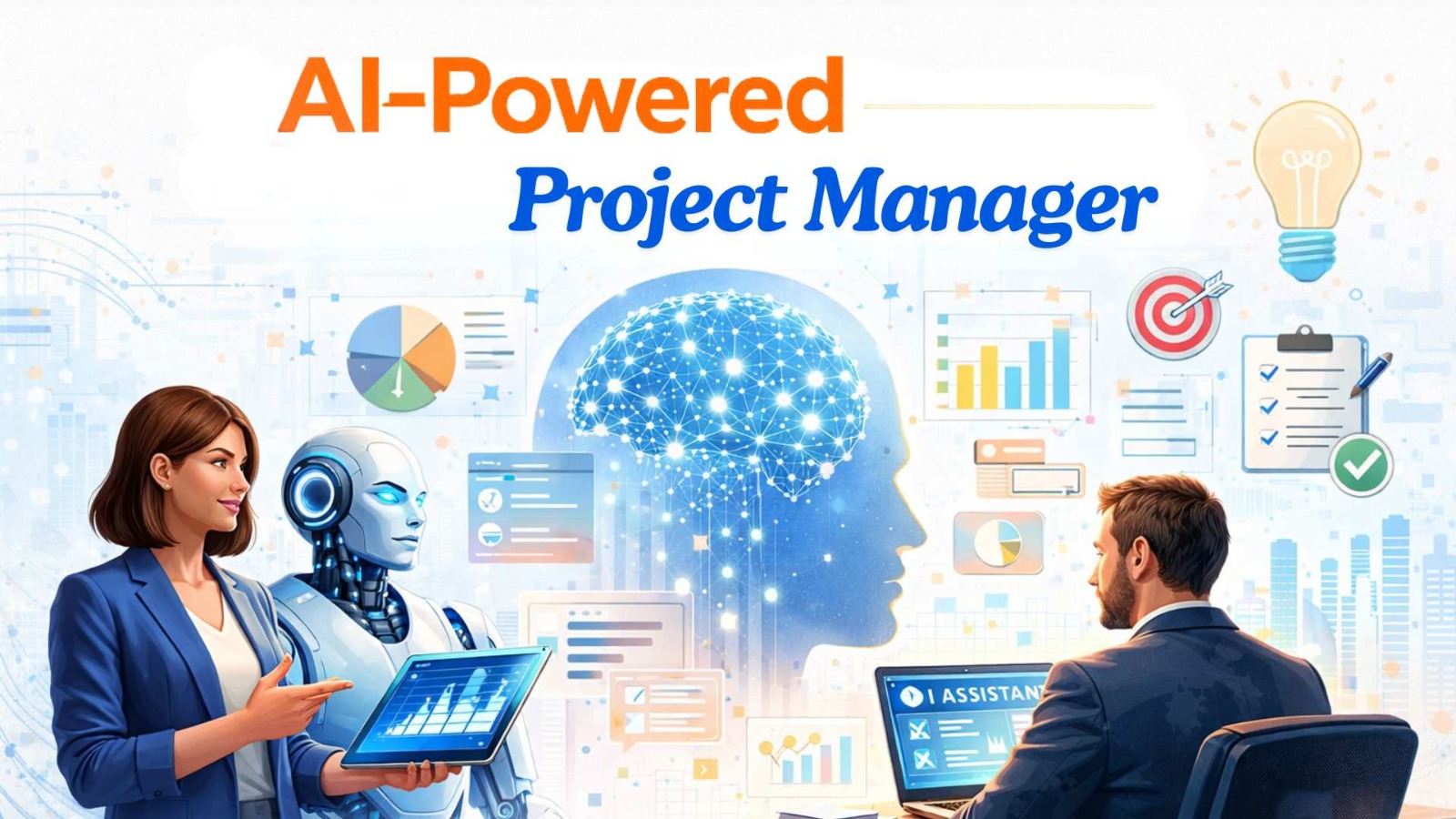
Learn how to apply AI across the full project lifecycle—from initial exploration to final delivery—shifting your workflow from manual effort to intelligent execution.

Who Should Attend?

  • Project Managers and Delivery Managers

  • Agile Coaches and Scrum Masters

  • Product Owners and Product Managers

  • Program Managers and Delivery Leaders

  • Tech Enthusiasts exploring GenAI in Agile

  • Anyone looking to leverage AI for insights, automation, and effective stakeholder communication

Pre-Requisites for AI-Powered Project Manager Workshop

  • Basic understanding of Project Management or Agile practices.

  • Familiarity with common PM activities.

  • No prior AI knowledge required.

  • Basic computer proficiency.

  • Access to a laptop with internet connectivity.

AI for Project Managers Content Outline

This intensive one-day session for capacity building, focusing on demonstrating practical knowledge that you can apply directly to your leadership roles. The program moves beyond simple prompting to explore how AI functions as a systemic solution within an enterprise environment.

The morning begins with a deep dive into why AI has suddenly become practical after decades of research. We explore the three core drivers: massive compute power (GPUs like NVIDIA), the data explosion from digitalization, and significant global investment.

Key Learning Outcomes:

  • The AI Hierarchy: Understanding the relationship between Artificial Intelligence, Machine Learning (ML), Deep Learning (DL), and Generative AI.
  • Mechanics of Intelligence: How algorithms and data come together to set parameters (the “nodes” of the AI brain) to predict patterns rather than truly “understand” them.
  • Model Sizing: Comparing Small, Medium, and Large models (like GPT-4 or Gemini) based on their reasoning power, cost, and deployment on edge devices versus the cloud.

We shift focus to Large Language Models (LLMs), explaining them as high-level prediction engines that generate responses word-by-word based on the context provided. You will learn that AI is not “intelligent” in the human sense but is exceptionally skilled at mimicking human-like interaction through pattern recognition.

Practical Hands-on:

  • The Prompting Framework: Moving past vague instructions to a structured format: Role + Context + Task + Format.
  • Meta-Prompting: Learning the advanced strategy of asking the AI to create a prompt for you to ensure higher-quality outputs for complex tasks like creating a risk register.
  • Exercise: Working in groups to generate a matured Risk Register for a sample project (e.g., an online bookstore), iterating on prompts to include probability/impact matrices and mitigation plans.

A common reason AI projects fail is a lack of project-specific context. This module introduces Grounding, the process of ensuring AI stays relevant to your specific project data rather than relying on generic internet knowledge.

Key Concepts:

  • Retrieval-Augmented Generation (RAG): Understanding how a system retrieves relevant files (like project FAQs or SOWs) and augments the user’s query with that context before the AI generates an answer .
  • Document Input Context: Using tools like NotebookLM to create a grounded knowledge base where the AI is restricted to answering only from provided sources .
  • Standalone vs. System AI: Recognizing the shift from “chatting” with a standalone tool to integrated AI—where a “Magic Button” inside Jira or YouTube handles the analysis automatically.

Project management is being transformed by seven core AI patterns recognized by industry leaders like PMI. We analyze how these patterns apply to your daily workflow to reach 3X to 5X productivity.

The Seven Patterns:

  1. Conversation: Chatbots and stakeholder interaction.
  2. Recognition: Converting unstructured data (whiteboard photos) into structured Jira tasks.
  3. Prediction: Forecasting cost variances and schedule delays (with a warning on data quality).
  4. Personalization: Tailoring status reports for different stakeholders (e.g., CEO vs. Technical Team) .
  5. Patterns & Anomalies: Detecting fraud or scope creep .
  6. Goal-Driven Systems: AI recommending actions to achieve specific objectives .
  7. Autonomous Systems: Agents acting independently with minimal human intervention .

In the most technical segment, we bridge the gap between project management and solution architecture. You will see that coding with AI (often called Vibe Coding) is no longer a barrier for managers.

Hands-on Activities:

  • API Management: Logging into Google AI Studio to generate an API key and understanding how this “key” allows your applications to “call” the AI model’s brain .
  • Google Apps Script: Integrating Gemini AI directly into Google Sheets.
  • Automated Backlog Generation: Watch a demonstration of a script that takes a single project Epic and automatically generates 120 detailed User Stories with acceptance criteria and Fibonacci-based story point estimations in one click .
  • Workflow Automation: A brief look at Make.com for orchestrating complex tasks across different apps (e.g., monitoring Reddit for project trends and emailing a summary).

As we move toward smaller teams and merged roles, the PM’s role evolves into a facilitator and compliance champion. We conclude by discussing the risks of deepfakes, hallucination, and the critical need for Human-in-the-loop (HITL) oversight.

Governance Highlights:

  • Responsible AI Principles: Ensuring fairness, accountability, transparency, and the removal of biases in AI-driven hiring or evaluation.
  • Regulatory Landscape: A summary of the EU AI Act and its risk-based categories (Unacceptable, High, and Minimal risk).
  • Data Boundaries: Establishing clear rules on what sensitive company data can and cannot be shared with public models .

The learning continues after the session through a dedicated WhatsApp group and access to the ai.izenbridge.com platform .
Assignments:
Case Study 1 (Planning): Using project narratives to build vision roadmaps and stakeholder registers .
Case Study 2 (Categorization): Training a model on sample defects to automatically categorize new project issues with a confidence score .
Case Study 3 (Reporting): Taking raw task data (dates, costs, completion %) and generating tailored reports for a CEO and a Compliance Officer.

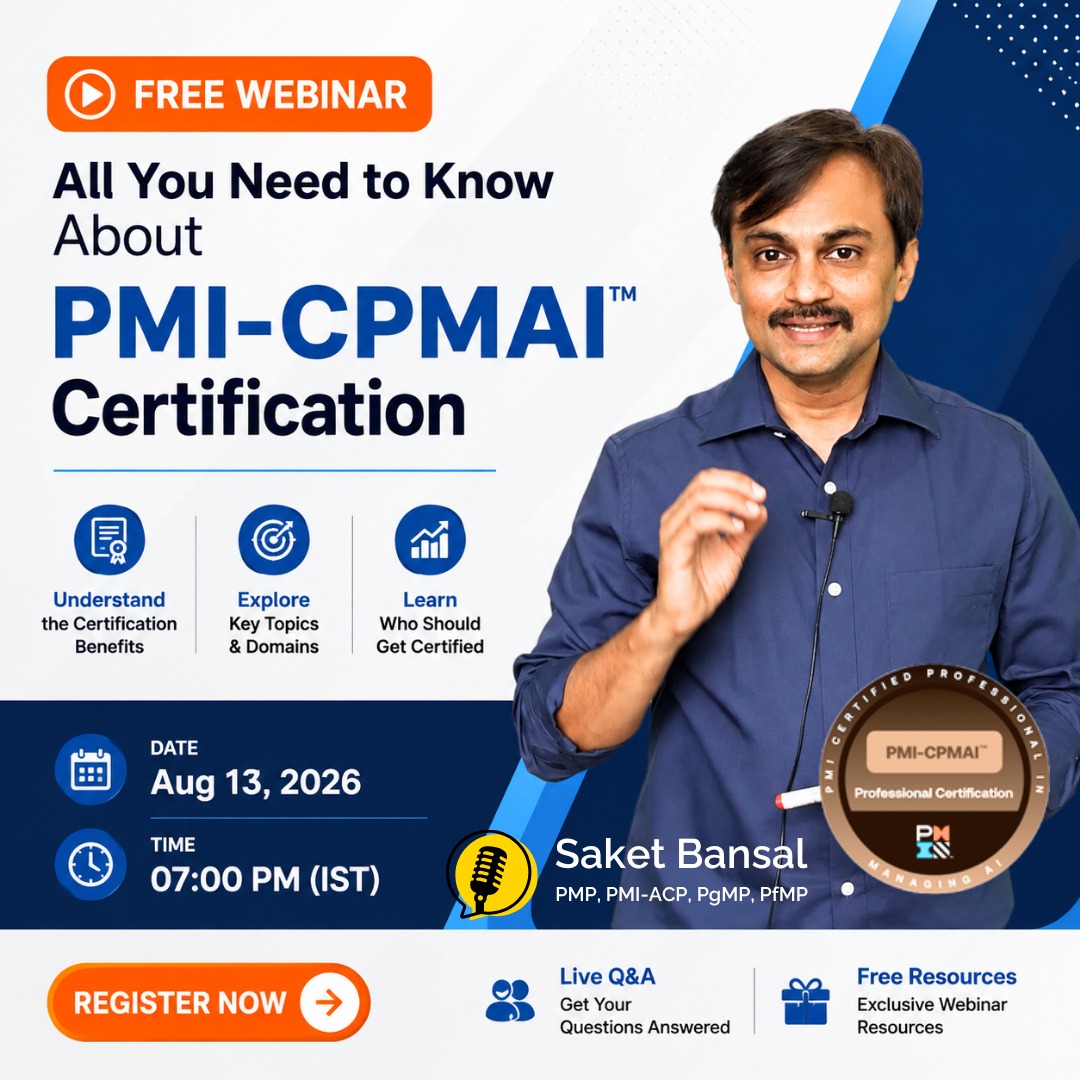
Lead by Industry Leading Trainers

Saket Bansal
Educator & Expert in PMP, PgMP, PfMP, PMI-ACP, SAFe, and Agile Coaching
Saket is a project Management enthusiast, a leading agile trainer and coach with experience in implementing and imparting project management practices amongst corporates and professionals. He is fo...
Experience : 27 + Years...
Trained : 15,000 + Participants

Related Programs

Our Trending Courses
AIPM-webinar