The post Understanding the 2024 PMI-ACP Exam Update: What’s New and What Remains the Same appeared first on iZenBridge.
]]>In this article, we’ll explore what remains the same in the 2024 exam, followed by a deep dive into the differences that bring fresh relevance to the certification.
What Remains the Same in the 2024 PMI-ACP Exam?
Despite the evolving nature of agile, the core principles and practices that make agile effective have stood the test of time. Let’s take a closer look at the foundational topics that remain unchanged in the 2024 PMI-ACP Exam Content Outline.
1. Agile Principles and Mindset
Agile principles and mindset continue to form the foundation of the PMI-ACP certification. This domain emphasizes understanding and embodying agile values and principles such as collaboration, adaptability, and continuous learning. Both the 2014 and 2024 outlines prioritize creating an agile mindset within teams and organizations, focusing on:
- Transparency: Open and honest communication remains essential to agile practices.
- Collaboration: Agile teams work together, fostering a culture of shared responsibility and mutual trust.
- Adaptability: Agile practitioners must embrace change and remain open to iterating on their work based on feedback and new insights.
In the 2024 update, agile principles are still at the core, reflecting their enduring importance for agile professionals.
2. Value-Driven Delivery
Delivering value incrementally to meet stakeholder needs is another timeless aspect of agile, emphasized consistently in both outlines. The focus on Value-Driven Delivery in 2014, which involved producing high-value increments, gathering feedback, and prioritizing deliverables, remains crucial in 2024.
Value-driven delivery enables agile practitioners to:
- Produce valuable work at every stage, aligning with evolving stakeholder needs.
- Maintain flexibility by gathering and incorporating feedback from each increment.
- Prioritize work based on potential impact and importance to stakeholders.
While the 2024 outline renames this domain as “Product,” the concept of delivering value remains consistent.
3. Stakeholder Engagement
Engaging stakeholders effectively has always been critical to agile’s success. Both outlines underscore the importance of building trust, setting clear expectations, and maintaining transparency with stakeholders.
This involves:
- Regular feedback loops: Gathering and integrating feedback to ensure that the product meets stakeholder requirements.
- Trust-building: Creating a collaborative environment where stakeholders feel engaged and valued.
- Managing expectations: Keeping stakeholders informed about progress, challenges, and changes to foster alignment.
Stakeholder engagement in the 2024 outline expands slightly to reflect agile leadership qualities, but the foundational principles remain.
4. Team Performance and Collaboration
Creating high-performing, self-organizing teams is another essential agile principle that remains unchanged. Both outlines emphasize:
- Empowerment and autonomy: Teams are encouraged to take ownership of their work, making decisions that drive quality and efficiency.
- Trust and openness: A team culture that values open communication fosters problem-solving and creativity.
- Continuous improvement: Agile teams must always seek ways to improve their processes, performance, and collaboration.
The 2024 outline builds on these ideas by adding a greater emphasis on agile leadership and team resilience, but the core concepts of team performance remain intact.
5. Adaptive Planning
Agile planning has always been adaptive, prioritizing flexibility to respond to new information, feedback, or changing conditions. Both outlines continue to support:
- Rolling wave planning: Creating plans in stages, refining them as the project progresses.
- Multi-level planning: Covering strategic, release, iteration, and daily planning to stay responsive to project needs.
- Stakeholder involvement: Engaging stakeholders in planning to align with expectations.
Adaptive planning remains a staple in agile, allowing practitioners to refine their approach and meet objectives efficiently.
6. Continuous Improvement
Continuous improvement at every level—product, process, and people—continues to be fundamental to agile. Both the 2014 and 2024 outlines encourage:
- Regular retrospectives: Conducting retrospectives after iterations to identify and implement improvements.
- A culture of learning: Promoting a mindset that values growth, learning, and adaptation.
- Process optimization: Seeking ways to streamline workflows and eliminate waste.
By retaining continuous improvement as a core principle, the PMI-ACP certification ensures that agile practitioners are equipped to foster a learning organization.
7. Problem Detection and Resolution
Early identification of risks, issues, and impediments remains a focus in both outlines. Agile practitioners are expected to:
- Promote visibility: Keeping issues transparent and encouraging open discussion for faster resolution.
- Proactive resolution: Addressing problems as they arise to maintain steady progress.
- Prevention: Implementing changes to reduce the likelihood of recurring issues.
Problem detection and resolution are integral to maintaining agile’s adaptability and alignment with project goals.
8. Tools and Techniques
Core agile tools and techniques, such as user stories, backlog prioritization, story mapping, and estimation methods like planning poker, are unchanged in the 2024 outline. These practices continue to support agile teams in managing workflows, measuring progress, and adapting to changing needs.
What’s New in the 2024 PMI-ACP Exam?
While around 70% of the content remains consistent, the 2024 PMI-ACP Exam Content Outline introduces several updates that reflect modern agile practices and respond to the complexities of today’s agile environments.
1. Psychological Safety and Emotional Intelligence
The 2024 outline places new emphasis on psychological safety and emotional intelligence as essential aspects of agile leadership. These topics address:
- Creating a no-blame culture that allows team members to share ideas openly.
- Using emotional intelligence skills like empathy and conflict resolution to foster a supportive environment.
- Encouraging transparency, which is essential for innovation and trust-building within teams.
2. Hybrid Agile Approaches
With many organizations now blending agile and traditional practices, the 2024 exam includes hybrid agile approaches. This addition allows agile practitioners to:
- Tailor agile practices to meet organizational needs, especially in regulated or structured environments.
- Combine elements from agile and traditional methodologies to create adaptable frameworks.
- Understand when and how to adapt agile practices in complex scenarios.
3. Experimentation and Innovation
The 2024 outline introduces a focus on experimentation and innovation, encouraging practitioners to create environments where iterative learning and testing are prioritized. This shift reflects agile’s adaptability, allowing teams to:
- Use feedback loops to test and refine ideas.
- Encourage creativity and experimentation to find the best solutions.
4. Advanced Agile Metrics and Flow Optimization
The 2024 exam adds new metrics, such as flow metrics (e.g., lead time, cycle time), to help teams track and optimize work efficiency. These metrics enable agile teams to:
- Use data-driven insights to manage productivity, quality, and risk.
- Make informed adjustments based on performance metrics.
5. Diversity, Equity, and Inclusion (DEI)
For the first time, Diversity, Equity, and Inclusion (DEI) principles are explicitly included in the PMI-ACP outline. This addition highlights the importance of fostering a culture where all team members feel respected and valued. Agile practitioners must now be prepared to:
- Build inclusive teams that benefit from diverse perspectives.
- Support psychological safety and equitable practices.
6. Remote and Distributed Team Dynamics
Reflecting the rise of remote work, the 2024 outline emphasizes remote and distributed team management. Agile practitioners must understand how to:
- Use tools to support virtual collaboration and communication.
- Maintain engagement and alignment across geographically dispersed teams.
7. Compliance and Regulatory Awareness
With more industries working within regulated environments, the 2024 outline includes compliance and regulatory awareness. Agile practitioners need to:
- Balance agile’s flexibility with regulatory requirements.
- Implement practices that align with both agile principles and industry-specific standards.
8. Sustainability and Resilience
The new outline highlights sustainability and resilience, encouraging practices that prevent burnout and promote long-term team health. Agile practitioners are now expected to:
- Foster sustainable work practices that prioritize well-being.
- Build resilience within agile teams to maintain productivity over time.
9. Agile Coaching and Mentorship
The 2024 outline introduces agile coaching and mentorship as part of agile leadership. Practitioners are encouraged to:
- Support team development through coaching and guidance.
- Build team maturity, enabling teams to achieve higher levels of agility.
Advice for Test Takers Preparing for the 2024 PMI-ACP Exam
If you’re preparing for the PMI-ACP exam, now is a strategic time to take action, especially given some transitional allowances from PMI. As part of the updated requirements, PMI now asks for 28 hours of agile study instead of the previous 21 hours. However, until March 31, 2025, PMI will still accept the previous 21 hours for exam applications. Additionally, once your application is approved, you have one full year to sit for the exam. Here’s a step-by-step guide to leverage this opportunity and streamline your path to certification:
1. Submit Your PMI-ACP Application Before March 31, 2025
If you’ve already completed 21 contact hours of agile training, this is an excellent time to apply before the requirements change to 28 hours. Submitting your application by the end of March 2025 allows you to make use of your existing study hours, saving you time and effort. This can be a great advantage for candidates who have been preparing under the previous guidelines.
2. Focus on the New Content Topics
Even though the application requirements temporarily allow the 21-hour minimum, the exam will test the new 2024 content outline. Be sure to cover the updated topics in your study plan, as they will reflect the broader scope of modern agile practices. In particular, emphasize learning in areas like:
- Psychological Safety and Emotional Intelligence: Understand how to create a psychologically safe, collaborative environment.
- Hybrid Agile Approaches: Familiarize yourself with integrating agile practices with traditional frameworks for complex environments.
- Advanced Metrics: Study flow metrics (e.g., lead time, cycle time) and how they support data-driven agile decisions.
- Compliance, Sustainability, and Resilience: Learn how these principles apply within agile environments.
These additions are highly relevant for today’s agile environments and likely to be emphasized in the new exam.
3. Leverage Your Existing Knowledge for Core Agile Topics
Since 70% of the exam content remains consistent with the previous outline, use your foundational knowledge to reinforce your preparation. Topics like agile principles, value-driven delivery, stakeholder engagement, team performance, adaptive planning, and continuous improvement will still play a major role in the exam. Balancing your study time between these core areas and the new topics can help you maintain a comprehensive understanding without having to start from scratch.
Conclusion
Preparing for the PMI-ACP exam under the 2024 guidelines may feel like a challenge, but with the right strategy, you can take advantage of PMI’s transitional allowances to complete your application and dive into the new topics. By focusing on the core agile principles you’ve already mastered and supplementing with study in the updated areas, you’ll be well-prepared to earn your PMI-ACP certification. Taking this proactive approach not only positions you to pass the exam but also equips you with a cutting-edge skill set that meets today’s agile demands.
With agile’s continued evolution, earning your PMI-ACP now will keep you at the forefront of agile best practices and provide a lasting credential that demonstrates your adaptability and readiness for the agile environments of the future.
The post Understanding the 2024 PMI-ACP Exam Update: What’s New and What Remains the Same appeared first on iZenBridge.
]]>The post PgMP Without PMP: Who Should Consider This Path? appeared first on iZenBridge.
]]>At first glance, the PMP seems like the logical first step, providing a foundation in project management practices and terminology. But for certain professionals, jumping straight to the PgMP may not only save time and resources but also provide a sharper focus on program management competencies. In this article, we’ll explore five situations where skipping the PMP and going directly for the PgMP is a strategic choice.
1. PgMP as a Differentiator, Not Just a CV Keyword
Let’s begin with the basic premise that PMP is one of the most widely recognized certifications in the field of project management. It’s often listed as a key requirement in job descriptions and serves as a keyword that helps get your CV noticed by recruiters.
However, if you’re already well-established in your field and not looking for a certification to help with CV selection, the PgMP can serve as a powerful differentiator. For professionals with 15+ years of experience, you’re not necessarily trying to pass the CV filter but instead, demonstrate advanced competencies in both project and program management.
? What does this mean for you? If you’re already recognized in your field and want to showcase your commitment to mastering program management, then PgMP is the certification that will set you apart during interviews and performance evaluations. It demonstrates not only experience but also a dedication to honing your skills at the program level, which goes beyond the operational nature of project management.
2. Time, Money, and the Need to Focus on Competency
Let’s talk about the practical aspects of certification: time and financial investment. While the PMP is invaluable for professionals starting their journey in project management, seasoned professionals may not need the foundational knowledge it provides. If your focus is squarely on program management, going straight for PgMP makes sense.
? Consider this: PMP preparation can be time-consuming, typically involving months of study. While it lays a solid foundation, if you are focused purely on program management, you might find that you don’t need to revisit those basics. PgMP preparation, although more expensive, typically requires about 40% less time than PMP preparation for experienced professionals.
Thus, if you’re someone whose experience already speaks for itself in the project management domain and you want to demonstrate advanced program management competencies, skipping the PMP and going straight for PgMP can save you both time and money.
3. Established Program Managers Focused on Building Expertise
If you’ve already established yourself as a program manager and feel confident in your project management skills, then it may not make sense to revisit those areas through the PMP. Instead, the PgMP can help you further solidify your expertise in program leadership and strategy.
? Who is this path for? Professionals who have successfully managed projects and are now focusing on program management as their core responsibility should consider skipping the PMP. For such individuals, pursuing the PgMP allows them to demonstrate their capability in managing large, complex programs without needing to revisit the foundational principles of project management.
By going directly for PgMP, you’re not only honing your skills but also aligning your career trajectory with a focus on program leadership rather than revisiting skills you’ve already mastered in the field.
4. You’re Managing Programs in Predictive Life Cycles or Large Government Programs
With the recent changes in the PMP exam, around 50% of the content is focused on Agile and hybrid project management approaches. For professionals managing programs that primarily operate in predictive environments—such as government programs, infrastructure, and large-scale industrial projects—this focus on Agile may not be relevant to your day-to-day responsibilities.
? Does this sound familiar? If you’re managing large programs where predictive or hybrid methods are the norm, and you don’t foresee a need for Agile methodologies in the future, the PMP may not add much value. Instead, pursuing PgMP allows you to concentrate on the competencies that matter most to you, like governance, program alignment, and benefits realization.
The PgMP focuses on managing programs at a strategic level, where the emphasis is more on aligning programs with organizational goals, managing interdependencies, and ensuring the realization of long-term benefits. For professionals in environments where Agile methodologies are less relevant, PgMP becomes the natural choice.
5. You’re Managing Agile Programs with Teams of Teams
On the flip side, if your experience is deeply rooted in managing Agile programs, particularly with a team-of-teams approach, the PMP’s detailed focus on predictive life cycles might not resonate with your current role.
? Why does this matter? Professionals managing Agile programs, especially in environments like software development or digital transformation, may find the PMP’s focus on predictive project management less useful. If you’re primarily focused on Agile methodologies and already have a deep understanding of how to manage projects in that environment, spending time on PMP’s predictive focus might not be the best use of your resources.
PgMP allows you to build on your existing Agile expertise while demonstrating competency in higher-level program management concepts, such as strategic alignment, governance, and the integration of multiple Agile teams to achieve overarching program objectives.
These five scenarios clearly demonstrate when it makes sense to skip the PMP and pursue the PgMP directly. Each situation shows how experienced professionals can strategically position themselves for success at the program level, focusing on competencies that matter the most for their career trajectory.
Is PgMP the Right Move for You?
So, is skipping the PMP and going straight for PgMP the right move for you? It comes down to your career trajectory, your experience, and where you want to focus your time and resources.
If you’re someone with 15+ years of experience who is already recognized in the field and looking to establish yourself as a top-tier program manager, then skipping the PMP could be the right decision. You’re focused on demonstrating competencies at the program level, where you’re managing large-scale initiatives, aligning them with strategic objectives, and driving long-term business value.
Conversely, if you’re in a role where Agile approach dominate your day-to-day activities, PgMP can help you maintain credibility without the need to revisit predictive project management concepts.
Why Enroll in Our PgMP Program?
We understand the unique needs of professionals at this level, which is why we offer tailored PgMP preparation programs that cater specifically to experienced professionals. Whether you opt for our self-paced learning or live virtual classes, we cover the necessary project management principles you need for the PgMP exam—without overloading you with unnecessary PMP content.
? What sets us apart?
- Time-efficient preparation: We’ve designed our program to minimize your study time while ensuring you’re fully prepared to pass the PgMP exam.
- Focused learning: We focus on the competencies that matter most for program managers, such as strategic alignment, governance, benefits realization, and program integration.
- Experienced instructors: Our instructors have years of experience in program management and can provide real-world examples and insights to enrich your learning experience.
In short, we’re here to help you pass the PgMP and take your career to the next level. Not doing PMP will not be a hurdle to your PgMP success—our program is designed to ensure you’re ready from both a content and exam perspective.
Conclusion: PgMP as Your Next Career Step
To summarize, if you’re an experienced professional already recognized in your field, skipping PMP and going straight for PgMP could be a strategic decision that saves you time, money, and effort. It’s all about where you are in your career and what you’re looking to demonstrate.
If you have any questions or want to discuss further how our program can help you achieve your PgMP, feel free to reach out. We’d love to help you navigate your path to program management excellence.
The post PgMP Without PMP: Who Should Consider This Path? appeared first on iZenBridge.
]]>The post How PMBOK Can Help You Prepare for PgMP Certification? appeared first on iZenBridge.
]]>Why PMBOK is Important for PgMP Certification
The PgMP certification focuses on managing complex programs composed of several interrelated projects. Therefore, program managers must have a deep understanding of project management to effectively govern and integrate projects. While the Program Management Standard addresses program-level concerns, PMBOK is an invaluable resource that helps program managers understand how to manage individual projects within the program.
PMI recommends PMBOK as part of your PgMP preparation because:
- Program Management Involves Project Management: A program is essentially a collection of related projects that are managed together to achieve greater benefits than managing them independently. Therefore, understanding project management concepts is crucial for effective program management.
- PMBOK Covers Core Project Management Concepts: Program managers need to be familiar with project management practices to guide, monitor, and coordinate the projects within their programs. PMBOK provides an excellent foundation for understanding the processes, tools, and techniques involved in managing projects.
- PgMP Exam Focuses on Governance and Integration: As a program manager, you are not expected to perform the day-to-day tasks of project managers, but you need to understand how project management is executed to provide oversight and guidance. PMBOK helps you understand the project management processes necessary for governance and integration at the program level.
Do You Need to Memorize PMBOK?
One of the most common concerns is whether candidates need to memorize PMBOK for the PgMP exam. The short answer is no. The PgMP exam is not a test of your ability to memorize the details of PMBOK, but rather an assessment of your understanding of project management concepts. You need to have a strong awareness of how project management is executed to effectively manage and guide project teams.
Familiarity with key project management concepts such as cost baselines, make-or-buy decisions, risk mitigation, and work breakdown structures (WBS) is crucial. However, memorization of the entire PMBOK is not necessary. Instead, focus on understanding the processes and how they relate to the projects within your program.
Which Version of PMBOK Should You Study?
A common question is which version of PMBOK to study. PMI recommends studying the latest version, PMBOK Guide 7th Edition, along with the Process Groups: A Practice Guide. However, if you have previously studied PMBOK Guide 6th Edition (or earlier versions) during your PMP certification, you can still use that material.
PMBOK Guide 6th Edition provides excellent coverage of the processes related to project management, and much of that content is still relevant for the PgMP exam. The PMBOK Guide 7th Edition, while useful, is more principle-based and may not go into as much detail on process groups. If you are familiar with PMBOK Guide 6th Edition and comfortable with its content, there is no need to switch to the latest edition for PgMP preparation.
For candidates who have studied earlier versions of PMBOK, such as PMBOK 5th or even 4th edition, the fundamental concepts of project management remain the same. You can use any version of PMBOK that you are familiar with, as long as you focus on the key topics that are relevant to program management.
Key Areas to Focus on from PMBOK for PgMP
As a program manager, your primary responsibility is to guide project managers and ensure the successful integration of all projects within the program. While you won’t be involved in the detailed tasks of individual projects, you must possess a solid understanding of key project management concepts. Here are the critical areas to focus on:
1. Guidance for Planning
As a program manager, it is essential to ensure that all projects within your program follow a consistent approach to planning. Your role involves guiding project managers in various planning processes, ensuring alignment with overall program objectives. This typically includes overseeing subsidiary plans in several areas, such as:
- Cost Management Plans: You need to understand how to guide the creation of cost management plans. Although you’re not responsible for creating cost baselines, you must ensure that project managers follow sound cost management practices.
- Scope Management Plans: Scope management is crucial for defining project boundaries. As a program manager, you will guide project managers to ensure that project scope aligns with the program’s broader goals.
- Schedule Management: While you’re not responsible for directly creating schedules, it’s important to understand the scheduling process. You will ensure that project managers develop realistic and well-coordinated schedules.
In addition to these, you should guide all other project management aspects, including Risk, Stakeholder, Procurement, Communication, Integration, Life Cycle Selection, Quality, and Resource Management, to ensure consistency across the program.
2. Monitoring and Governance
After guiding the planning phase, your focus shifts to demonstrating a strong understanding of monitoring and governance processes. Here are some key topics:
- Earned Value Management (EVM): As a program manager, you will monitor project performance using metrics like the Cost Performance Index (CPI) and Schedule Performance Index (SPI). These metrics help track whether projects are progressing on time and within budget.
- Variance Analysis: Keeping track of cost and schedule variances is essential. You will use this information to provide feedback and guidance to project teams.
- Risk Management: Managing risks at both the project and program levels is critical. As a program manager, you need to ensure that project managers are effectively identifying and addressing risks, and escalate project risks to the program level when necessary.
3. Stakeholder Engagement
Stakeholder engagement is one of the most important areas in program management. You must ensure that stakeholders are engaged, informed, and aligned throughout the program. PMBOK offers comprehensive coverage of stakeholder engagement, and this knowledge is directly applicable to the PgMP exam.
4. Procurement Management
Procurement processes are often handled at the program level, particularly when multiple projects share vendors or suppliers. Understanding procurement strategies, selecting contract types, and managing vendor relationships are essential for ensuring the program meets its procurement needs efficiently.
5. Risk Management
Risk management plays a crucial role at both the project and program levels. You should have a solid understanding of key risk management concepts, including risk identification, assessment, and response strategies. Additionally, you will need to guide the escalation of risks from the project to the program level when necessary.
6. Cost Management
In particular, understanding earned value management (EVM) and other cost control metrics is critical for overseeing the program’s budget and financial health.
7. Project Integration and Change Control
Responding to changing situations is a core responsibility for program managers. This involves overseeing the integration of multiple projects and ensuring that changes are managed effectively through proper change control processes.
8. Schedule Adjustments
You should understand important scheduling terms and techniques, such as critical path, crashing, and fast-tracking, to ensure that the program remains on track and timelines are managed efficiently.
9. Communication Planning and Governance
Clear communication is vital for program success. As a program manager, you will guide communication planning and ensure governance structures are in place to facilitate effective communication among stakeholders and project teams.
What Areas Are Less Relevant?
While PMBOK is a valuable resource, not all topics are equally important for the PgMP exam. You can spend less time on the following areas:
- Team Management: Program managers are not directly involved in managing project teams. Topics related to team development, motivation, and resource management are less critical at the program level.
- Detailed Scope and Schedule Creation: Although you provide guidance on scope and schedule management, you won’t be responsible for creating detailed scope statements or schedules. Focus instead on high-level coordination and integration of project-level efforts.
- Resource Management: While resource allocation is important, the day-to-day management of resources is handled by project managers. Your focus should be on ensuring resources are aligned with program objectives.
How to Use PMBOK for PgMP Preparation
To effectively use PMBOK for your PgMP exam preparation, focus on the following steps:
- Skim Through Familiar Sections: If you have studied PMBOK before, skim through sections that you are already familiar with. Focus on refreshing your memory of key project management concepts, such as cost management, stakeholder engagement, and risk management.
- Understand Concepts, Not Details: For the PgMP exam, you need to understand project management concepts at a high level. Focus on how these concepts apply to managing multiple projects within a program rather than memorizing detailed processes.
- Review Monitoring and Controlling Processes: Pay close attention to the monitoring and controlling processes in PMBOK. These processes are crucial for tracking program progress and ensuring that projects remain aligned with program objectives.
- Use Your Existing PMBOK Materials: Whether you studied PMBOK 5, 6, or 7, the core concepts remain the same. Use whatever materials you are most comfortable with and supplement them with more recent resources, such as the Process Groups: A Practice Guide, if needed.
Conclusion
PMBOK is a valuable resource for anyone preparing for the PgMP certification. While the Program Management Standard is the primary guide, PMBOK helps program managers understand the project management processes that are essential for governing and integrating the various projects within a program. By focusing on key concepts such as cost management, risk management, and stakeholder engagement, you can effectively prepare for the PgMP exam without memorizing every detail of PMBOK. Remember, the goal is to have a solid understanding of project management principles, so you can provide oversight and guidance at the program level.
Enroll in our PgMP Mentoring Program today and gain the guidance, tools, and support you need to confidently navigate the PgMP certification journey and excel in your program management career!
The post How PMBOK Can Help You Prepare for PgMP Certification? appeared first on iZenBridge.
]]>The post Mastering Program Management Principles: A Guide for PgMP Exam Preparation appeared first on iZenBridge.
]]>This blog explores the core Program Management Principles and how they can help you prepare for the PgMP exam, ensuring you understand the mindset and approach needed to manage large, complex programs effectively.
1. Stakeholder Engagement
Stakeholders are individuals or groups affected by the program or who perceive themselves as being impacted by it. A key responsibility of the program manager is to ensure that stakeholder expectations are aligned with the program’s objectives and the business benefits it seeks to deliver. This alignment is crucial throughout the program’s life cycle and must be proactively maintained.
- PgMP Exam Focus: You’ll need to understand how to identify, analyze, and engage stakeholders continuously. Questions will likely focus on resolving conflicts between stakeholders and maintaining alignment with the program’s strategic goals.
A good approach is to regularly reassess your engagement strategy, ensuring that stakeholders’ needs are met and that they are kept informed of the program’s progress. The PgMP exam often tests your ability to adapt to changing stakeholder expectations while still ensuring alignment with the overall program objectives.
2. Benefit Realization
The principle of Benefit Realization emphasizes the importance of delivering value through the program. It’s not just about producing deliverables but ensuring that these deliverables generate benefits aligned with the organization’s strategic objectives.
- PgMP Exam Focus: The exam will test your understanding of benefit identification, tracking, and sustainment. You should be able to explain how program benefits are realized incrementally, measured, and transitioned to operational teams for long-term success.
- PgMP Exam Focus: The exam will test your understanding of benefit identification, tracking, and sustainment. You should be able to explain how program benefits are realized incrementally, measured, and transitioned to operational teams for long-term success.
A program manager must keep the focus on benefits rather than just deliverables. The ability to identify, measure, and sustain these benefits is critical, and this principle forms the basis of many questions in the PgMP exam.
3. Synergy
The essence of program management lies in creating synergy—bringing together multiple projects or components to achieve benefits that could not be realized independently. Program managers must focus on integrating the activities of component projects to maximize overall program benefits.
- PgMP Exam Focus: You’ll be expected to demonstrate how you would ensure integration and coordination across multiple components. This includes managing dependencies, resources, and ensuring that the work done in each component contributes to the program’s overall success.
Effective synergy management allows different projects to collaborate, share resources, and innovate together. The PgMP exam often includes scenarios where you need to balance different life cycles (predictive, adaptive) while ensuring overall program success.
4. Team of Teams
Program management often involves managing a network of teams working across various components. The principle of Team of Teams focuses on creating an interconnected structure where teams can collaborate vertically and horizontally, working toward a common strategic goal.
- PgMP Exam Focus: You’ll need to understand how to facilitate collaboration between multiple teams, ensuring communication and coordination at both the component and program levels.
In the PgMP exam, you may encounter questions about managing large, complex programs with multiple teams and ensuring they are aligned. This principle also ties closely to leadership and change management, both of which are core to the PgMP curriculum.
5. Change Management
Change is inevitable in any program, and effective Change Management is critical to ensuring that the program remains aligned with its objectives, even as internal and external environments evolve. Program managers must adapt to these changes while maintaining a focus on benefit realization.
- PgMP Exam Focus: You’ll be tested on your ability to manage change within a program, especially in dynamic and long-term environments. The exam often includes questions on how to respond to regulatory, economic, or organizational shifts that could impact the program’s progress.
Managing change effectively requires integrating new information, adjusting plans, and ensuring that all stakeholders and teams are aligned with the changes. The ability to adapt and guide a program through change is a critical skill tested in the PgMP exam.
6. Leadership
Effective leadership is the cornerstone of successful program management. As a program manager, you are expected to inspire, influence, and guide your teams and stakeholders toward achieving program goals.
- PgMP Exam Focus: Leadership questions in the PgMP exam will often test your ability to balance leadership and management, motivate teams, resolve conflicts, and drive collaboration.
In a program management context, leadership involves both influencing stakeholders and guiding multiple teams across different projects. The PgMP exam evaluates your understanding of situational leadership, where different scenarios require different leadership styles and approaches.
7. Risk Management
Risk is a natural part of program management, and effective Risk Management ensures that uncertainties do not derail the program from achieving its objectives. Program managers must be proactive in identifying, analyzing, and mitigating risks to keep the program on track.
- PgMP Exam Focus: Risk management is a heavily tested area in the PgMP exam. You’ll need to demonstrate your understanding of both positive (opportunities) and negative (threats) risks, how to mitigate them, and how they impact benefit realization.
Program managers must create a risk-aware culture within their teams and ensure that risks are managed at both the component and program levels. You may also be tested on your ability to escalate risks to senior management when necessary.
8. Governance
Governance ensures that the program is executed according to organizational policies, complies with regulatory requirements, and achieves its strategic goals. It provides oversight and ensures accountability throughout the program life cycle.
- PgMP Exam Focus: Governance questions will test your ability to set up a governance framework, manage compliance, and ensure transparent decision-making processes.
In the PgMP exam, governance often overlaps with other principles like benefit realization, change management, and risk management. You’ll need to understand how governance structures are applied across the program life cycle and how they support effective decision-making.
Conclusion: Preparing for the PgMP Exam
Mastering these Program Management Principles is essential for success in the PgMP exam. Each principle—from Stakeholder Engagement to Governance—forms the foundation of program management, providing the mindset and tools needed to manage complex, large-scale programs effectively.
These principles are interconnected and serve as the guiding force behind every decision and action in a program. By understanding and applying these principles, you’ll be well-prepared to answer the wide range of questions you’ll encounter in the PgMP exam.
If you’re preparing for your PgMP certification and need support, be sure to check out our comprehensive PgMP exam preparation programs. We offer self-paced learning, live mentoring, and application guidance to help you pass the PgMP exam efficiently and confidently. Explore our PgMP exam preparation offerings today!
The post Mastering Program Management Principles: A Guide for PgMP Exam Preparation appeared first on iZenBridge.
]]>The post PgMP Exam Success: Mastering the Essential Performance Domains appeared first on iZenBridge.
]]>Let’s explore the core performance domains and their importance in managing a successful program.
1. Strategic Alignment
Strategic Alignment ensures that the program’s objectives are directly connected to the overall goals of the organization. For example, if an organization in the e-commerce industry aims to become a leader in its field, a program might be initiated to improve market share and operational efficiency.
In this domain, program managers focus on:
- Defining program objectives that align with organizational strategy.
- Maintaining alignment throughout the program lifecycle, adjusting for any changes in external environments, such as market opportunities or threats.
- Ensuring that program components (projects within the program) are delivering outputs and outcomes that support the organization’s strategic goals.
This domain also heavily influences the governance framework and benefit management processes, as both are crucial to maintaining strategic alignment. In the PgMP exam, understanding how to keep a program aligned with strategic objectives is a frequently tested topic.
2. Benefit Management
The Benefit Management domain focuses on ensuring that the program delivers tangible and intangible benefits that support the organization’s goals. Benefits are what provide value to the organization, and they must be clearly identified, measured, and sustained throughout the program.
Program managers must:
- Identify the expected benefits at the start of the program.
- Continuously track and measure these benefits, ensuring they are realized incrementally.
- Sustain the benefits after the program is completed, ensuring a smooth transition to operations for long-term value.
For example, in an e-commerce program, reducing checkout times by 40% could be a key benefit that improves customer satisfaction and increases sales. Similarly, reducing inventory waste by 60% might boost operational efficiency. Both tangible and intangible benefits need to be measured and sustained.
Benefit Management also ties closely with Strategic Alignment, as benefits must support the overall strategic goals of the organization. The PgMP exam often tests on the identification, tracking, and realization of benefits, so it’s crucial to understand this domain in depth.
3. Stakeholder Engagement
Effective Stakeholder Engagement is essential in any program. Programs involve various stakeholders, both internal (e.g., employees, leadership) and external (e.g., vendors, regulatory bodies). Stakeholders have different levels of influence and interest, and managing these relationships is a key responsibility of a program manager.
Key activities in this domain include:
- Identifying and analyzing stakeholders, often using tools like the Power-Interest Grid to prioritize attention and resources.
- Creating effective communication channels to build trust and keep stakeholders informed.
- Continuously engaging stakeholders to ensure their support and alignment with program goals.
Stakeholder expectations can fluctuate over time, and program managers must be adaptive, maintaining a proactive approach to managing conflicts, aligning interests, and ensuring ongoing support. Stakeholder engagement is a major area tested in the PgMP exam, focusing on relationship management and conflict resolution.
4. Governance
The Governance domain establishes the oversight mechanisms that guide the program toward achieving its strategic objectives. Governance ensures that decision-making, accountability, and compliance processes are in place to keep the program on track.
Program managers are responsible for:
- Setting up a clear governance framework that defines roles, responsibilities, and decision-making authority.
- Implementing escalation procedures for issues that exceed defined thresholds.
- Tracking performance and conducting milestone reviews to ensure transparency and accountability.
Governance also plays a critical role in ensuring compliance with both regulatory requirements and organizational policies. A strong governance framework enables program managers to make informed decisions about continuing, modifying, or terminating program components based on performance. This is a key area in the PgMP exam, with questions focusing on setting up and managing governance structures.
5. Collaboration
Collaboration is the glue that holds a program together, ensuring that all program components (projects) and stakeholders work synergistically toward common goals. Effective collaboration leads to better communication, transparency, and alignment across the program.
In this domain, program managers focus on:
- Ensuring synergy between program components and stakeholders, avoiding internal conflicts that could hinder progress.
- Facilitating open communication to ensure that everyone is aligned with the strategic goals and program outcomes.
- Managing conflicts as they arise to maintain productivity and collaboration.
Collaboration extends beyond internal teams to include external stakeholders, such as vendors and partners. Effective collaboration reduces risks and improves overall program performance. This domain also connects with stakeholder engagement and governance. The PgMP exam often includes scenarios requiring candidates to demonstrate how they would foster collaboration in complex program environments.
6. Life Cycle Management
The Life Cycle Management domain provides structure to the entire program, guiding it from initiation to closure. It connects all the other performance domains and helps program managers ensure a smooth flow of activities.
The program life cycle typically consists of three phases:
- Program Definition: In this phase, the program is initiated, and the strategic alignment and benefit management processes are established. Program planning also occurs here.
- Program Delivery: This phase focuses on executing the program components, delivering outputs, and realizing benefits. Program managers must ensure that these outputs contribute to the program’s strategic objectives and benefits.
- Program Closure: The final phase involves closing out the program, ensuring all deliverables have been transitioned to operations, and benefits can be sustained in the long term.
Life Cycle Management serves as the backbone of program management, ensuring that all performance domains are effectively integrated. Questions in the PgMP exam often test the candidate’s ability to manage programs through the entire life cycle, from initiation to closure.
Conclusion
Understanding and mastering the Program Management Performance Domains is essential for anyone preparing for the PgMP exam. These domains—Strategic Alignment, Benefit Management, Stakeholder Engagement, Governance, Collaboration, and Life Cycle Management—cover the core responsibilities and challenges faced by program managers in complex organizational environments.
By focusing on these areas, program managers can ensure their programs deliver value, align with strategic objectives, engage stakeholders effectively, and operate within a solid governance framework. For those aiming to pass the PgMP exam, a thorough understanding of these domains is a crucial step toward success.
Explore our PgMP exam preparation offerings to accelerate your journey toward certification and ensure your success in mastering the performance domains
The post PgMP Exam Success: Mastering the Essential Performance Domains appeared first on iZenBridge.
]]>The post Mastering Procurement in Project Management for PMP Success appeared first on iZenBridge.
]]>This guide breaks down the procurement process, aligning it with key PMP exam concepts, while providing practical examples to ensure that PMP aspirants grasp its importance. The Procurement topic is relevant equally for PMP and PgMP Exam.
What is Procurement in Project Management?
Procurement refers to the acquisition of goods or services from external vendors to meet project requirements. It typically arises when the project team lacks the expertise, resources, or time to deliver specific project elements internally. Whether you’re developing software, constructing a building, or implementing an IT solution, the decision to procure externally can significantly impact cost, timelines, and project outcomes.
The Typical Procurement Process
The procurement process generally follows a sequence of key steps, each essential for ensuring that external resources align with project needs. Although procurement activities can vary based on the project type, the following steps represent a typical flow.
Make-or-Buy Decision
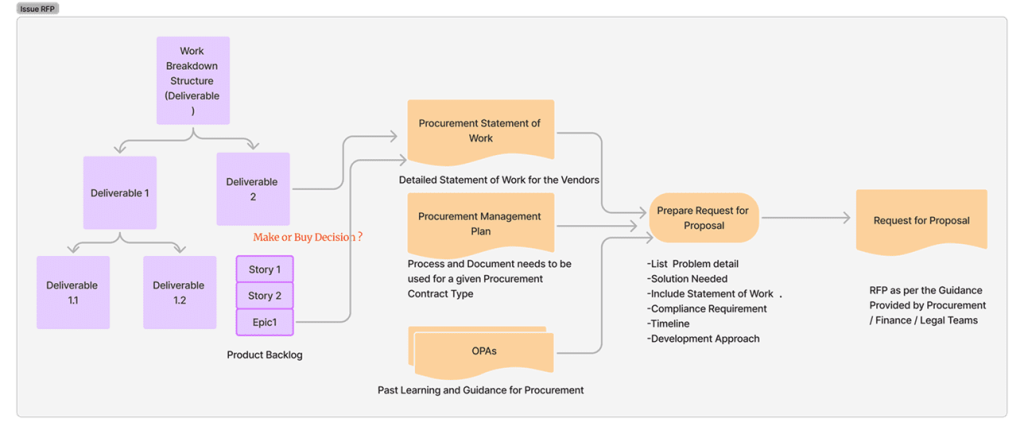
The Make-or-Buy Decision is a critical first step in the procurement process, where the project manager determines whether it is more cost-effective and efficient to perform the work internally or to outsource it to an external vendor. This decision is influenced by several factors, including cost, expertise, availability of resources, and time constraints.
As a project manager, you may perform this analysis at various stages of the project:
- During the initial scope definition, when preparing the project scope, you may decide that certain portions of the work are better outsourced due to lack of internal resources or specialized expertise.
- Later in the project, this decision may arise as a risk response strategy. For instance, if internal resources are insufficient or schedules are at risk, transferring the work to an external party might be necessary to mitigate delays.
- Alternatively, outsourcing can also be viewed as an opportunity to accelerate project timelines by leveraging external capabilities that are faster or more cost-effective.
In a predictive life cycle, the Work Breakdown Structure (WBS) is a key tool that helps identify which components of the project might need external resources. In contrast, adaptive or agile projects may involve outsourcing specific Product Backlog items such as user stories or epics that are beyond the internal team’s capacity.
From a PMP exam perspective, you should expect to evaluate various scenarios where making or buying decisions must be based on economic analysis, time efficiency, and project-specific variables. It’s essential to understand how this decision fits into the broader procurement strategy.
As a project manager, you should establish a structured Make-or-Buy Decision process as part of your Procurement Management Plan, ensuring consistency and alignment with project objectives.
For those preparing for the PgMP exam, the role extends beyond individual projects to guiding the decision-making framework across multiple projects within a program. You would be responsible for ensuring that project teams apply the right criteria when making these decisions, considering the overall program objectives, resource optimization, and risk management.
Preparing the Procurement Statement of Work (SOW)
After deciding to procure work externally, the next critical step is to prepare the Procurement Statement of Work (SOW). The SOW is a formal document that clearly defines the scope of the outsourced work, the deliverables expected, and the vendor’s responsibilities. It serves as the foundation for ensuring both the project team and the vendor have a mutual understanding of the project’s requirements, facilitating a smooth procurement process.
The Procurement SOW is not just a technical document; it is a key communication tool that bridges expectations between the project manager and the vendor. By clearly outlining the work to be performed, it minimizes ambiguity, ensuring that the vendor understands exactly what is required to meet the project’s objectives.
Typical Elements in the SOW:
- Problem Description: A clear articulation of the issue or need that the outsourced work is intended to address.
- Expected Solution or Service: Defines the solution or service the vendor is expected to deliver.
- Compliance Requirements: Any regulatory, legal, or organizational standards the vendor must adhere to.
- Timelines and Deadlines for Deliverables: Specific dates for when the work must be completed and handed over.
- Criteria for Success: The measurable benchmarks or quality standards that will be used to assess whether the vendor has successfully met the project requirements.
The SOW plays a crucial role in preparing the Request for Proposal (RFP), which invites vendors to submit their bids based on the defined work.
When following a predictive life cycle, where the project scope is well understood upfront, the SOW can be detailed and specific. In such cases, tools like the Work Breakdown Structure (WBS) and the WBS Dictionary can be used to develop a thorough SOW, outlining the exact components of work to be outsourced.
However, in projects following an adaptive or agile life cycle, the SOW may evolve over time as more is learned about the project’s needs. In such cases, the SOW might not be as detailed in the initial stages, but it will still communicate the key objectives and the expected outcomes from the vendor. As the project progresses and clarity is gained, the SOW can be refined to provide more specific guidance to the vendor.
Preparing the Request for Proposal (RFP)
Once the Procurement Statement of Work (SOW) is completed, the next step in the procurement process is preparing the Request for Proposal (RFP). The RFP is a formal document issued to potential vendors, inviting them to submit proposals that outline how they will meet the project’s requirements. It serves as the foundation for selecting the right vendor, as it provides clear details about the scope of work, timelines, and expectations.
An RFP is particularly valuable when dealing with complex procurements, where multiple factors—such as technical capabilities, compliance, and cost—need to be evaluated before awarding the contract. It allows vendors to present tailored solutions and pricing structures, helping the project manager and procurement team assess which vendor can deliver the best value.
Key Components of an RFP
When preparing an RFP, it is essential to ensure that the document provides comprehensive information for vendors to submit accurate and competitive proposals. The following are the key components typically included in an RFP:
- Problem or Need Description: A clear explanation of the issue or project need that requires external support.
- Solution Requirements: Detailed specifications for the solution or service the vendor is expected to provide, including any technical requirements.
- Compliance and Regulatory Guidelines: Any specific legal, regulatory, or organizational standards the vendor must comply with.
- Timelines and Milestones: Clearly defined deadlines for submitting the proposal and completing the deliverables.
- Budgetary Constraints: If applicable, include any budget limits or financial expectations for the proposal.
- Type of Contract: Specify the type of contract (e.g., fixed price, time and materials, cost-reimbursable) you intend to use, based on the nature of the procurement.
- Evaluation Criteria: Define the criteria by which vendor proposals will be evaluated (e.g., cost, quality, technical expertise, past performance).
Considering the Procurement Management Plan
The Procurement Management Plan plays a critical role in shaping the content of the RFP. It provides guidance on the procurement strategy, outlining specific procedures, templates, and approval processes that must be followed. Project managers should collaborate closely with the procurement and legal teams to ensure that the RFP aligns with organizational policies and legal requirements. In many cases, your procurement team may provide templates or standardized formats to streamline the process.
RFP vs. RFQ
It’s important to distinguish between a Request for Proposal (RFP) and a Request for Quotation (RFQ). An RFQ is typically used for straightforward procurement where the main concern is price, such as acquiring goods or materials with clearly defined specifications. In contrast, an RFP is used for more complex procurements where the solution may vary based on vendor expertise, and factors like quality, innovation, and customization need to be considered.
Receiving Proposals from Qualified Vendors
Once the Request for Proposal (RFP) is issued, the next step in the procurement process is to gather proposals from qualified vendors and evaluate their submissions. This phase is critical, as it ensures that the project receives well-considered bids from vendors capable of delivering the required work.
Identifying and Inviting Qualified Vendors
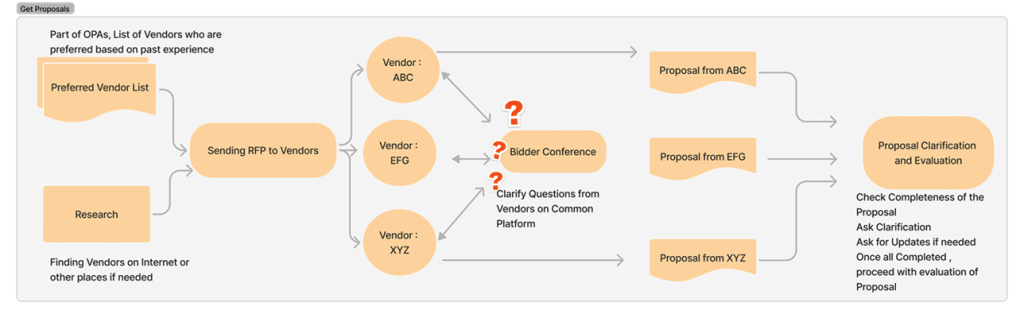
Before sending out the RFP, the project manager, in collaboration with the procurement team, must identify a list of qualified vendors. This is often done using several approaches:
- Preferred Vendor Lists: Many organizations maintain a list of pre-approved or preferred vendors with whom they have previously worked. These vendors are often trusted to deliver reliable results and meet the organization’s standards.
- External Research: If no suitable vendors are available from the preferred list, the procurement team may conduct market research to identify new potential vendors. This could involve industry referrals, market analysis, or outreach to specific companies.
- Open Invitation: For some procurements, the RFP may be advertised publicly to attract a broader range of bids, especially when the organization is seeking innovation or competitive pricing.
Providing Clarifications and Conducting Bidder Conferences
After the RFP has been sent to vendors, some may require clarification on certain aspects of the scope, timeline, or requirements. It’s crucial to ensure that all vendors have a clear and common understanding of the project before they submit their proposals.
To address any questions or uncertainties, the project manager may:
- Answer Individual Queries: Vendors may submit questions directly, which can be addressed one-on-one via email or during meetings.
- Conduct a Bidder Conference: For complex projects, it may be beneficial to hold a bidder conference. This is a meeting where all potential vendors can gather, ask questions, and receive answers at the same time. This ensures transparency and helps all vendors have the same level of information, reducing the risk of misunderstandings or incomplete proposals.
The bidder conference is a valuable opportunity to clarify expectations, provide additional details, and ensure vendors fully understand the requirements outlined in the RFP.
Initial Screening for Completeness
Once the deadline for submission passes, the project manager and procurement team will begin receiving vendor proposals. At this stage, it is important to ensure that each proposal is complete and addresses all the requirements outlined in the RFP. The process typically involves the following steps:
The first step is to perform a completeness check on each proposal to ensure that all necessary information is provided. This includes verifying that:
- All sections of the proposal are filled out.
- Required documents, such as pricing details, technical specifications, and compliance certifications, are included.
- The proposal adheres to the RFP’s format and submission guidelines.
If any proposal is missing key details, the project manager may ask the vendor for clarification or additional documentation. In highly regulated environments, incomplete proposals may be automatically disqualified, depending on the rules established in the Procurement Management Plan.
Once the proposals are received from vendors, the next phase of the procurement process involves a thorough evaluation of the submissions, followed by contract negotiation and final agreement. These steps ensure that the project team selects the most qualified vendor and establishes a contract that aligns with the project’s objectives.
Evaluation of Proposals Using Source Selection Criteria
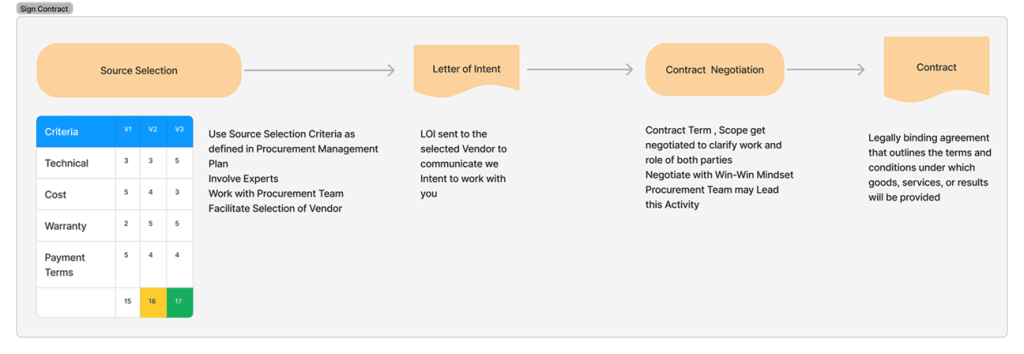
After completing the initial check for completeness, the project manager and procurement team begin a more detailed evaluation of the proposals using Source Selection Criteria. These criteria are predefined in the Procurement Management Plan and help the team assess how well each vendor’s proposal meets the project’s needs.
Common Source Selection Criteria include:
- Technical Quality: How well does the proposal demonstrate the vendor’s ability to meet technical requirements and deliver the necessary services or products?
- Cost: Is the proposed cost competitive and within the project’s budget? Does the pricing reflect the value of the work being offered?
- Compliance: Does the vendor meet all regulatory, legal, and organizational requirements?
- Risk: How does the vendor’s solution mitigate risks? Are there potential risks in the vendor’s ability to meet deadlines or quality standards?
- Past Performance: Has the vendor successfully delivered similar projects before? What do references or past project data reveal about their reliability?
A scoring matrix or weighted system is often used to ensure objectivity. Each vendor is assigned a score for each criterion, with more critical factors such as technical capability or cost receiving higher weightage. This allows the project manager and evaluation team to compare vendors fairly and transparently.
Once the evaluations are completed, the highest-ranking vendor(s) are identified for the next stage—contract negotiation.
Issuing the Letter of Intent (LOI)
After the top vendor has been identified, a Letter of Intent (LOI) is often issued. The LOI signals the project team’s intention to enter into formal contract negotiations with the selected vendor. It is not a legally binding contract but serves as a preliminary agreement that allows both parties to proceed with negotiations in good faith.
The LOI typically includes:
- A statement indicating that the vendor has been selected.
- An outline of key terms and conditions that are likely to be included in the final contract.
- An invitation to the vendor to begin formal negotiations to finalize the agreement.
The LOI helps both parties align on expectations before entering detailed negotiations, ensuring a smooth transition to contract discussions.
Contract Negotiation
Contract negotiation is a critical phase where the project manager, procurement team, and vendor work together to finalize the terms of the agreement. The goal of this process is to ensure that the contract reflects the project’s scope, deliverables, budget, and timelines while aligning with the vendor’s capabilities.
Key areas of focus during negotiations include:
- Scope and Deliverables: Finalizing the details of what the vendor will deliver and the specific milestones they will be held accountable for.
- Payment Terms: Establishing payment schedules, including any upfront payments, progress payments tied to milestones, or final payments upon project completion.
- Risk Sharing: Defining responsibilities for risk management, including how risks will be shared between the vendor and the project team. This could include penalties for delays or incentives for early delivery.
- Legal Terms: Ensuring that both parties agree to legal protections, intellectual property rights, and any other compliance-related matters.
During negotiations, it’s crucial for the project manager to maintain a win-win mindset, ensuring both parties are satisfied with the terms. Negotiations should focus on transparency, collaboration, and ethical practices, as these principles are often tested on the PMP exam.
Reaching the Contract Agreement
Once the negotiation process is completed, the final step is to formalize the contract agreement. This contract is a legally binding document that outlines all aspects of the vendor’s work and the project’s expectations. It serves as the foundation for managing the vendor relationship throughout the duration of the project.
Key components of the final contract include:
- Scope of Work: A detailed description of the work to be performed, including specifications, deliverables, and timelines.
- Payment Terms: Clear terms regarding how and when the vendor will be paid, including provisions for any performance-based incentives or penalties.
- Type of Contract: The agreed-upon contract type (e.g., fixed price, time-and-materials, cost-reimbursable).
- Legal and Compliance Terms: Any necessary legal provisions, such as intellectual property rights, non-disclosure agreements, and compliance with industry regulations.
The project manager must ensure that the contract aligns with the project’s objectives and timelines and that it protects the organization’s interests. Once both parties agree to the terms, the contract is signed, and the procurement process moves into the execution phase.
The Role of the Project Manager in Procurement
In project management, procurement is often seen as a function largely handled by procurement or finance departments. However, the project manager plays a crucial role in ensuring that procurement aligns with the project’s overall objectives and deliverables. As a project manager, it is important to collaborate closely with the procurement team, even if they handle the administrative aspects, to ensure that the contracted work supports the project’s success.
Here’s a breakdown of the project manager’s role in procurement, focusing on the key areas where their involvement is essential:
Aligning Procurement with Project Objectives
The primary responsibility of the project manager in procurement is to ensure that any external work procured aligns with the project’s overall goals and deliverables. It’s essential that the procurement team understands the scope and nature of the work that needs to be outsourced. This involves:
- Ensuring that the procurement requirements reflect the project scope and quality standards.
- Collaborating with procurement professionals to ensure that contract terms account for the project’s timelines and deliverables.
- Communicating effectively with the procurement team so that they understand the critical aspects of the project and can factor those into vendor selection and contracts.
It’s vital to avoid situations where the procurement team selects vendors or establishes contracts that don’t align with the project’s ultimate goals. The project manager is responsible for making sure that the procurement team is well-informed and aligned with the project’s objectives.
Developing and Implementing the Procurement Management Plan
A key task for the project manager is to develop the Procurement Management Plan, which outlines how procurement activities will be handled during the project. This plan includes:
- The type of procurement processes to be used (e.g., competitive bidding, sole sourcing).
- The contract types that are most appropriate for the project, such as fixed-price, time-and-materials, or cost-reimbursable contracts.
- The evaluation criteria for selecting vendors, including technical expertise, cost, and quality.
The Procurement Management Plan ensures that procurement activities are executed consistently and in alignment with both organizational policies and the specific needs of the project.
Managing Collaboration with the Procurement Team
While procurement departments handle many of the technical aspects of vendor selection and contract negotiations, the project manager is responsible for ensuring that the procurement team’s actions align with the project’s needs. The project manager:
- Provides oversight to ensure that the procurement process stays on track.
- Clarifies project requirements to the procurement team, ensuring they understand the nuances of what is being outsourced.
- Supports negotiations by clarifying how the project scope and deliverables may impact the vendor relationship or contract terms(Procurement Open Hour)(Comprehensive Guide to …).
Involvement in Vendor Selection and Contract Negotiation
The project manager works closely with the procurement team during vendor selection and contract negotiation. Although procurement professionals may lead these activities, the project manager provides input to ensure the selected vendor meets the project’s needs and timeline. Responsibilities include:
- Reviewing vendor proposals to ensure they align with project goals.
- Participating in negotiations, particularly where the project scope or deliverables need clarification or adjustment.
- Ensuring that the contract includes provisions for risk management, compliance, and change control.
Monitoring and Managing Vendor Performance
Once the contract is in place, the project manager’s role shifts to monitoring vendor performance and managing the relationship throughout the project. This includes:
- Ensuring deliverables are completed on time and meet the agreed-upon quality standards.
- Managing risks related to vendor performance and escalating any issues through the contract’s dispute resolution mechanisms.
- Facilitating communication between the vendor and the project team, ensuring that the vendor has access to any project-related information they need to fulfill their contract obligations.
The project manager also plays a role in managing changes to the vendor’s scope of work, ensuring any necessary amendments are negotiated and documented properly.
Contract Closure
Finally, the project manager is responsible for ensuring that all contracted work is completed and that the contract is formally closed. This involves:
- Verifying that all deliverables have been met according to the contract.
- Ensuring that all payments are processed and no further liabilities exist.
- Archiving contract documents and lessons learned for future reference
Conclusion
Procurement is a fundamental aspect of project management, especially when outsourcing becomes necessary to meet project objectives. Understanding the procurement process, from making the decision to buy or build, to managing vendor relationships and negotiating contracts, is essential for project success. For PMP and PgMP exam takers, mastering procurement is crucial as it spans across multiple domains and processes within the exam framework. A strong grasp of procurement not only enhances your project management skills but also ensures the smooth execution of your projects, keeping them aligned with your goals and objectives.
If you’re preparing for the PMP exam and want to accelerate your preparation, check out our comprehensive PMP program page. Our resources, expert-led guidance, and structured content will help you master not only procurement but all the critical areas of project management, giving you the edge to succeed in your PMP certification journey.
The post Mastering Procurement in Project Management for PMP Success appeared first on iZenBridge.
]]>The post PMP vs. PgMP: Choosing the Right Certification for Your Project Management Career appeared first on iZenBridge.
]]>What is the PMP Certification?
The PMP certification, offered by the Project Management Institute (PMI), is one of the most recognized credentials in project management. It validates your ability to manage projects effectively, ensuring they meet specified goals within constraints like time, cost, and quality.
A project is a temporary endeavor undertaken to create a unique product, service, or result. It is characterized by a specific goal, defined deliverables, and a set timeline. Projects are designed to bring about a change or achieve something that is not currently being done. They have a clear beginning and end, with the primary focus on delivering a unique output that meets the project’s objectives.
- Key Characteristics of a Project:
- Temporary: Projects have a defined start and end date.
- Unique Deliverables: Each project produces a unique outcome, whether it’s a product, service, or result.
- Goal-Oriented: Projects are initiated to achieve specific goals or objectives that align with the organization’s strategy.
The skills and knowledge required to manage a project are encompassed within project management, and the PMP certification is designed to validate a professional’s competency in these areas.
Key Aspects of PMP Certification:
- Scope: Focuses on individual project management, covering various approaches, including predictive (waterfall), agile, and hybrid approaches.
- Exam Content Outline:
- People: Develop leadership skills, manage conflicts, and engage stakeholders.
- Process: Handle communication, manage risks, budgets, schedules, and ensure quality.
- Business Environment: Align projects with organizational strategy, manage compliance, and adapt to environmental changes.
- Eligibility Criteria:
- Education: A four-year degree (or equivalent).
- Experience: 36 months of project management experience within the last eight years. If person is not having education below degree than 60 months of project management experience.
- Training: 35 contact hours of project management education, which can be obtained through accredited training programs or CAPM Certification.
Specific Advice from Industry Experts on PMP
Highlighting Leadership in Practical Experience: When documenting your experience for the PMP application, ensure it emphasizes your leadership and management roles. Positions like Scrum Master or Team Leader are valuable, provided they demonstrate your ability to lead teams toward achieving project objectives. Clearly articulate how you influenced project outcomes, managed teams, and resolved challenges, aligning your experience with PMI’s expectations for project leadership.
Understanding Agile and Hybrid Focus: PMI has officially stated that 50% of the PMP exam will now focus on Agile and Hybrid methodologies. It’s crucial to be well-versed in these areas, even if your primary experience is in traditional project management. Make sure your preparation includes a strong emphasis on Agile principles, frameworks, and how they integrate with Hybrid approaches to meet the diverse needs of modern projects.
Mastering People Skills for the Exam: Given that 42% of the PMP exam revolves around people skills, it’s essential to hone your abilities in areas like conflict management, team development, and stakeholder engagement. The exam often presents scenario-based questions that test your ability to apply these skills in real-world situations. Prepare by practicing how to handle interpersonal challenges and lead teams effectively, as these are critical for passing the exam.
Strategic Training Recommendations: Completing the required 35 contact hours is just the starting point. Choose training programs that not only cover the PMP exam content but also integrate practical insights from seasoned project managers. This dual approach ensures you’re not just memorizing concepts but also understanding how to apply them in real-world scenarios. Opt for training providers who offer a blend of theoretical knowledge and practical application, preparing you for both the exam and on-the-job challenges.
Curating Your Study Materials Wisely: With an overwhelming amount of PMP study material available online, the key to exam success is quality over quantity. Focus on a few high-quality resources rather than trying to consume everything available. Select study guides, books, and online courses from reputable sources that offer comprehensive coverage of the exam content. Limiting your resources helps maintain focus and ensures a deeper understanding of the material.
Prioritizing High-Quality Mock Tests: Mock tests are a critical component of your PMP exam preparation. However, it’s vital to choose mock exams that accurately reflect the complexity and format of the real exam. High-quality mock tests not only familiarize you with the exam structure but also challenge you to apply your knowledge in scenarios similar to those you’ll encounter on exam day. Seek out mock tests from trusted sources that are known for their rigor and alignment with the actual PMP exam.
What is the PgMP Certification?
The PgMP certification, also from PMI, is designed for professionals who manage multiple related projects as a cohesive program. This credential is ideal for those overseeing complex programs that align with strategic goals and deliver significant benefits.
A program is a collection of related projects that are managed and coordinated as a group to achieve strategic objectives and deliver benefits that would not be possible if the projects were managed individually. Programs are often ongoing and can evolve as new projects are added or existing projects are completed. The primary focus of program management is on aligning the outcomes of the various projects to the organization’s strategic goals, optimizing resources, and ensuring that the collective deliverables contribute to a broader benefit.
Key Characteristics of a Program:
- Interrelated Projects: A program consists of multiple projects that are related and contribute to the overall strategic objective.
- Strategic Alignment: Programs are aligned with the organization’s long-term goals and ensure that all projects within the program contribute to these goals.
- Benefit Realization: Programs focus on delivering benefits and value that exceed the sum of the individual projects’ outcomes.
Program management requires a higher level of coordination and integration, focusing on benefits realization, stakeholder engagement, and strategic alignment. The PgMP certification is designed to validate a professional’s expertise in managing programs and ensuring that the projects within the program are collectively achieving the desired strategic outcomes.
Key Aspects of PgMP Certification:
- Scope: Focuses on managing programs—a collection of interrelated projects managed together to achieve strategic objectives.
- Exam Content Outline:
- Strategic Program Management: Aligning programs with organizational goals.
- Program Life Cycle: Managing the program from initiation to closure.
- Benefits Management: Ensuring the program delivers expected benefits.
- Stakeholder Engagement: Managing relationships with stakeholders across the program.
- Governance: Ensuring the program adheres to organizational policies and objectives.
- Eligibility Criteria:
- Education: A four-year degree (or equivalent).
- Experience:
- Four years (48 months) of project management experience.
- Four years (48 months) of program management experience within the last 15 years.
- Application Process: The PgMP application is rigorous, requiring detailed descriptions of program management experience and a panel review by PMI.
Specific Advice from Industry Experts on PgMP
Mastering the Program Management Standard: A critical step in preparing for the PgMP exam is to thoroughly study the Program Management Standard 5th Edition. This standard provides an in-depth understanding of program management principles, processes, and best practices. Since the PgMP exam is closely aligned with the content of this standard, gaining a solid grasp of the material will help you answer exam questions accurately and confidently. Focus on understanding the intricacies of program management, including the strategic alignment of projects, benefits realization, and governance.
Understanding the PgMP Exam Content Outline: The PgMP Exam Content Outline is an essential resource that details the specific tasks and responsibilities of a program manager across all domains of program management. It breaks down the exam content into actionable tasks, providing clarity on what is expected of a program manager in real-world scenarios. Make sure you study this outline thoroughly, as it will guide your preparation and help you focus on the key areas that will be tested. Understanding the outline ensures that you are well-prepared to demonstrate your competence in all aspects of program management, from stakeholder engagement to risk management.
Application Strategy: Your PgMP application is a critical component of the certification process. It requires you to provide detailed descriptions of your program management roles, with a focus on leadership, strategic alignment, benefits realization, stakeholder engagement, risk management, and governance. PMI conducts a thorough review of your experience to ensure it aligns with their standards. To improve your chances of success, craft your application meticulously, providing specific examples that highlight your contributions and impact in these areas. A well-prepared application not only reflects your expertise but also sets the foundation for the subsequent panel review.
Crafting Strong Essay Responses: As part of your PgMP application, you will need to answer three essay-style questions that delve into your experience in program management leadership, stakeholder engagement, and governance. Each response should be approximately 500 words, offering clear and detailed examples of your skills and accomplishments. These essays are your opportunity to showcase your strategic thinking, problem-solving abilities, and the tangible results you’ve achieved in your programs. Take the time to craft thoughtful, well-structured responses that demonstrate your depth of experience and understanding of program management.
Leveraging Mentorship and Quality Mock Tests: The PgMP certification process can be complex and challenging, but you can speed up your progress by seeking mentorship from PgMP-certified professionals. A mentor can provide valuable guidance, share insights from their own experience, and help you navigate the application process more efficiently. Additionally, practicing with high-quality mock tests is crucial to your success. These tests should accurately reflect the complexity and format of the actual PgMP exam, helping you build confidence and identify areas where you need further study. Combining mentorship with rigorous practice will significantly enhance your readiness for both the application and the exam.
Comparing PMP and PgMP: Which One is Right for You?
While both PMP and PgMP certifications are valuable, they cater to different stages of a project management career. Here’s a comparative overview to help you decide which certification aligns best with your career goals:
| Aspect | PMP | PgMP |
|---|---|---|
| Focus | Managing individual projects | Managing a program of related projects |
| Primary Audience | Project Managers | Program Managers |
| Certification Complexity | High (Application and Exam) | High (Application, Panel Review, and Exam) |
| Prerequisites | 3 years of project management experience | 4 years each of project and program management experience |
| Career Advancement | Suited for advancing within project management roles | Suited for transitioning to or advancing within program management roles |
| Salary Impact | Significant (16% higher median salary) | Potentially higher but varies by industry |
| Global Recognition | Over 1.4 million PMP holders globally | Around 10,000 PgMP holders globally |
The Investment: Time, Money, and Effort
Both PMP and PgMP certifications require significant investments of time, money, and effort. Here’s a breakdown to help you plan effectively:
Costs:
- PMP Certification:
- Exam Fee: Approximately 560 USD , in India it will be around 35,000 INR Plus GST, find pricing for your region here
- PgMP Certification:
- Exam Fee: Approximately $950 USD, in India it will be around 56,000 INR Plus GST, find pricing for your region here
Time Commitment:
- PMP Preparation: Typically requires 100-150 hours of study over 2-3 months. Start your preparation by focusing on areas where you have less experience, such as agile methodologies or risk management.
- PgMP Preparation: Due to the complexity of the exam and the application process, expect to spend 150-200 hours over 4-6 months. If PMP Concepts are fresh and clear to you it will take 30 to 100 hours.
Conclusion: Elevate Your Career with the Right Certification
PMP Certification: The PMP certification is ideal for professionals currently managing projects who wish to strengthen their project management expertise. It’s also a recommended first step for those aspiring to move into program management. PMP certification provides a robust foundation in project management principles, which are crucial for tackling the complexities of program management. Additionally, many recruiters still look for PMP certification, even for program management roles, due to its global recognition and validation of core project management skills.
PgMP Certification: The PgMP certification is tailored for professionals who are already working in or transitioning to program management roles. As organizations increasingly establish positions such as Program Manager, Technical Program Manager, and Non-Technical Program Manager, a PgMP certification becomes a key differentiator. It is especially valuable for those aiming to take on senior management roles where strategic alignment, benefits realization, and governance are critical. However, we strongly advise completing the PMP certification first, as it lays the groundwork for your program management journey and meets the expectations of many recruiters. The PgMP then serves as an advanced credential that sets you apart as a leader in program management.
Both certifications offer significant opportunities for career advancement, leading to higher salaries, better job prospects, and recognition as an expert in your field. By earning these certifications, you demonstrate your commitment to professional growth and your ability to deliver value to your organization through effective project and program management.
To support you on your journey, consider enrolling in our PMP and PgMP preparation programs. We provide comprehensive training, study resources, and personalized support to help you succeed. Start your journey today and take the next step towards elevating your career in project and program management.
Links for Further Information
For more details and personalized guidance, feel free to reach out to us or visit our website to learn how we can support you in achieving your certification goals.
The post PMP vs. PgMP: Choosing the Right Certification for Your Project Management Career appeared first on iZenBridge.
]]>The post Project Kickoff Meeting: A Comprehensive Guide for Project Managers appeared first on iZenBridge.
]]>What is a Project Kickoff Meeting?
A project kickoff meeting is the first official meeting between the project team and the key stakeholders, where the project manager introduces the project, clarifies objectives, discusses the project plan, and establishes a foundation for communication and collaboration. The primary purpose of this meeting is to ensure that all parties are aligned on the project’s vision, goals, and approach, and to set expectations for the project’s progress.
Importance of the Kickoff Meeting
The project kickoff meeting is essential for several reasons:
- Alignment on Objectives: It ensures that all stakeholders and team members have a clear understanding of the project’s goals and what is expected to be delivered.
- Establishing Roles and Responsibilities: It clarifies who is responsible for what, preventing confusion and overlap in responsibilities.
- Building Relationships: It provides an opportunity for team members and stakeholders to meet and begin building relationships, which is critical for effective collaboration.
- Setting Expectations: It sets the tone for the project’s communication, timelines, and processes, establishing a shared understanding of how the project will be managed.
When to Conduct a Kickoff Meeting?
The timing of the kickoff meeting can vary depending on the project’s complexity and duration. Generally, it is recommended to hold the kickoff meeting within the first week of the project. For shorter projects, the kickoff meeting might be scheduled within the first few days. For longer or more complex projects, it might be reasonable to allow up to two weeks to gather the necessary information and stakeholders.
Preparing for the Kickoff Meeting
As the project manager, you are responsible for planning and conducting the kickoff meeting. Preparation is key to a successful meeting. Here are the steps you should follow:
- Stakeholder Identification: Identify who should attend the meeting. This includes key stakeholders, project sponsors, team members, and any external parties who have a significant role in the project.
- Agenda Creation: Develop a detailed agenda that covers all critical topics, such as project overview, objectives, scope, roles, communication plan, risks, and next steps.
- Document Review: Review all relevant documents, including the project charter, contracts, and any preliminary project plans. This will help you understand the project’s context and prepare for potential questions.
- Presentation Preparation: Create a presentation that clearly outlines the project’s key aspects. This should include slides on the project’s vision, objectives, scope, timeline, roles, communication plan, risks, and action items.
- Coordination: Ensure that all necessary logistics are handled, including scheduling the meeting, booking a room or virtual meeting space, and sending out invitations.
Conducting the Kickoff Meeting
During the kickoff meeting, follow the agenda to ensure that all critical topics are covered. Here’s a breakdown of the main sections of a typical project kickoff meeting:
- Welcome and Introductions: Start with a brief introduction, welcoming the participants and introducing key team members and stakeholders. This sets a friendly and collaborative tone for the meeting.
- Project Overview: Provide a high-level overview of the project, including the project’s vision and objectives. Explain why the project is important and what it aims to achieve.
- Scope and High-Level Plan: Discuss the project’s scope, including what is in scope and what is out of scope. Present the high-level project plan, including major milestones and deliverables.
- Roles and Responsibilities: Clarify the roles and responsibilities of each team member and stakeholder. Use a RACI matrix (Responsible, Accountable, Consulted, Informed) to clearly define who is responsible for each aspect of the project.
- Communication Plan: Outline the communication plan, including how often meetings will occur, what reports will be distributed, and how stakeholders will be kept informed.
- Risk Management: Identify potential risks and discuss how they will be managed. This includes any assumptions that have been made and what the impact would be if those assumptions prove to be incorrect.
- Quality and Change Control: Discuss the quality standards the project must meet and the process for managing changes to the project scope or objectives.
- Action Plan: Present an immediate action plan, detailing the first steps the team will take to move the project forward.
- Q&A and Closing: Open the floor to questions from participants to clarify any uncertainties. Finally, summarize the key points discussed and reiterate the importance of alignment and collaboration.
Sample Kickoff Meeting Presentation
To aid in understanding, a sample kickoff meeting presentation has been provided. This sample is designed to guide project managers through creating effective kickoff meeting slides. The presentation covers all the critical elements discussed above and is adaptable to various project types and organizational templates.
Download the Sample Presentation: Sample Project Kick-Off Meeting Presentation (PPT/PDF)
This template can be customized to fit the specific needs of your project and organization. It provides a solid foundation for ensuring that your project starts on the right foot.
Frequently Asked Questions (FAQs)
Do we need to conduct a kickoff meeting in adaptive or hybrid life cycles?
Yes, a kickoff meeting is essential even in adaptive or hybrid life cycles. While these approaches may involve more iterative planning and continuous refinement, the kickoff meeting ensures that all stakeholders and team members are aligned on the high-level goals and framework for the project. It sets a common understanding before diving into detailed discussions like user stories or backlog refinement.
Does the client need to attend the kickoff meeting?
It depends on the project’s nature and the client’s role. In some cases, the client’s presence is crucial for setting high-level goals and expectations. This is particularly beneficial for fostering a shared understanding and establishing a strong working relationship. However, there may be scenarios where the kickoff meeting is conducted internally first, with a separate session involving the client later.
Is a kickoff meeting mandatory for every project?
While a kickoff meeting is highly recommended, especially in projects with new teams, complex scopes, or multiple stakeholders, there can be exceptions. For example, if the project is a continuation of previous work with the same team, a formal kickoff might not be necessary. However, it’s crucial to ensure that all parties have a shared understanding of the project’s goals, whether through a formal meeting or another communication method.
Conclusion
The project kickoff meeting is a foundational event that significantly influences the success of a project. By ensuring that all stakeholders and team members are aligned on the project’s goals, scope, and approach, the kickoff meeting helps prevent misunderstandings and sets the stage for effective project execution. With thorough preparation and clear communication, the project manager can use the kickoff meeting to build momentum and confidence in the project’s success.
Use the insights and resources provided in this article to conduct a successful project kickoff meeting and set your project on the path to success. Join our PMP program to accelerate your exam preparation and elevate your project management skills, ensuring you are fully equipped to succeed in your certification journey and beyond.
The post Project Kickoff Meeting: A Comprehensive Guide for Project Managers appeared first on iZenBridge.
]]>The post Understanding the Relationship Between Portfolio, Program, Operations, and Project Management appeared first on iZenBridge.
]]>In this blog, we’ll explore the relationship among these key management areas, drawing on a practical example that illustrates their interaction within a typical business scenario.
A Practical Example: The Pizza Chain
To illustrate the relationship among Portfolio, Program, Operations, and Project Management, let’s consider a fictional company—an established pizza chain with multiple stores across the country. This company is constantly delivering value to customers through its primary product: pizza. However, the delivery of this value involves much more than just baking and serving pizzas. It encompasses various ongoing activities that are critical to the company’s success.
Operations: The Backbone of Value Delivery
Operations are the activities that keep the pizza chain running smoothly on a daily basis. These include:
- Hiring and training staff
- Procuring ingredients
- Managing logistics
- Running marketing campaigns
- Maintaining store infrastructure
These activities are continuous and do not have a defined end date. As long as the company is in business, these operations must be maintained. Operations are the backbone of value delivery, ensuring that the company can consistently meet customer demands and maintain its competitive edge.
External Factors and Strategic Planning
Like any business, our pizza chain operates in an environment influenced by various external factors such as competition, market trends, and customer preferences. These factors require the company’s leadership to continuously assess and refine their business strategy.
For instance, the company’s CEO might decide to diversify the product offering by entering the coffee market, expand into smaller cities, or invest in technology to automate order-taking processes. These strategic decisions are crucial for the company’s long-term success.
Portfolio Management: Turning Strategy into Action
Once the company’s leadership has defined the strategy, the next step is to decide how to implement it. This is where Portfolio Management comes into play. Portfolio Management involves evaluating various strategic ideas and determining which ones to pursue based on factors like:
- Cost-benefit analysis
- Alignment with organizational goals
- Resource availability
- Risk assessment
In our pizza chain example, the portfolio management team might consider multiple strategic initiatives, such as automating the order-taking process and diversifying into the coffee market. They would then assess these ideas to decide which ones to prioritize and fund.
The Role of Portfolio Management
Portfolio Management is responsible for ensuring that the organization’s resources are allocated to the right projects and programs that will deliver the most significant strategic benefits. These benefits might include increased revenue, market expansion, or operational efficiency.
Program Management: Managing Interconnected Projects
Once the portfolio management team has decided to pursue a particular strategic initiative, the next step is to implement it. This is where Program Management comes in. A program is a collection of related projects that are managed in a coordinated way to achieve broader organizational objectives.
Example: Automating Order-Taking Processes
Suppose the portfolio management team decides to move forward with the initiative to automate order-taking processes across all stores. This initiative would likely involve several interconnected projects, such as:
- Evaluating different point-of-sale systems
- Piloting the selected system in a few stores
- Training staff on the new system
- Rolling out the system to all stores
These projects would be managed as part of a program, with the program manager overseeing the execution to ensure that all projects align with the overall objective of improving operational efficiency.
Program Management vs. Project Management
It’s important to note that while program management focuses on managing related projects as a collective unit, project management is concerned with the execution of individual projects. Project managers are responsible for delivering specific project outcomes within the constraints of scope, time, and cost.
The Integration of Operations with Projects and Programs
Once the projects within a program are completed, the deliverables—such as the new automated order-taking system—are transitioned to the operations team. This team is responsible for incorporating the new system into their daily activities, ensuring that it functions effectively and delivers the intended benefits.
Collaboration is Key
For the company to achieve its strategic goals, there must be close collaboration between the operations, program, and portfolio management teams. The operations team must be involved early in the process to ensure that they are prepared to adopt the new systems or processes being developed.
In our pizza chain example, even the most advanced automated order-taking system will fail to deliver value if the operations team is not adequately trained or resistant to change. Therefore, the success of the company’s strategic initiatives depends on the seamless integration of project and program deliverables into everyday operations.
Multiple Portfolios: Managing Complexity
In larger organizations, it’s common to have multiple portfolios, each focused on different aspects of the business. For example, one portfolio might focus on technology initiatives, while another focuses on growth and market expansion. These portfolios are managed separately but must be aligned with the organization’s overall strategic objectives.
In our pizza chain example, the company might have separate portfolios for in-store operations and online sales, each with its own set of projects and programs. This approach allows the company to manage complex initiatives more effectively while ensuring that all efforts contribute to the company’s long-term goals.
Why Understanding These Relationships Matters
For professionals in project and program management, understanding the relationship between portfolios, programs, operations, and projects is critical. This knowledge enables them to:
- Align their work with organizational strategy
- Effectively manage resources and risks
- Ensure that project and program deliverables are integrated into operations
- Contribute to the overall success of the organization
Advancing Your Career with PMP and PgMP Certifications
For those looking to deepen their understanding of these concepts and advance their careers, pursuing certifications like PMP and PgMP can be highly beneficial.
PMP Certification: Mastering Project Management
The PMP certification is designed for professionals who want to demonstrate their expertise in managing projects. It covers essential topics such as:
- Project Life Cycle Management
- Leadership and People Management
- Risk management
- Stakeholder communication
- Resource management
By earning a PMP certification, you’ll gain the skills needed to manage individual projects effectively, ensuring that they contribute to the organization’s broader goals.
PgMP Certification: Elevating to Program Management
For those interested in taking their career to the next level, the PgMP certification focuses on program management. This certification is ideal for professionals who manage multiple, related projects and are responsible for achieving strategic objectives. The PgMP certification covers topics such as:
- Program governance
- Strategic Alignment
- Benefit management
- Stakeholder engagement
- Program life cycle management
By earning a PgMP certification, you’ll be equipped to manage complex programs that deliver significant strategic value to your organization.
Conclusion: Integrating Knowledge for Organizational Success
Understanding the relationship among portfolio, program, operations, and project management is crucial for driving organizational success. By effectively managing these interconnected areas, professionals can ensure that their work aligns with the organization’s strategy, resources are used efficiently, and the desired benefits are achieved.
Whether you’re a project manager looking to enhance your skills with a PMP certification or a program manager aiming for a PgMP certification, mastering these concepts will enable you to contribute more effectively to your organization’s success.
Are you ready to take your career to the next level? Explore our PMP and PgMP certification programs and start your journey towards becoming a strategic leader in your organization today!
| Name | Date | Place | – |
| PMP Certification and Training | 15 – 30 November 2025 | Bangalore | More Details |
| PMP Certification and Training | 9 Dec’25 – 7 Jan’26 | Chennai | More Details |
The post Understanding the Relationship Between Portfolio, Program, Operations, and Project Management appeared first on iZenBridge.
]]>The post Program and Program Management: Defining the Role of the Program Manager appeared first on iZenBridge.
]]>In the dynamic world of project management, mastering the coordination of multiple related projects to achieve strategic objectives is essential. This is where program management becomes critical. As an advanced discipline, program management involves the holistic management of a group of related projects, ensuring that they work together to deliver maximum benefits and align with the overarching goals of the organization. For professionals aiming to excel in this field, the PgMP Certification offers a recognized pathway to gain the expertise needed to effectively manage complex programs and drive strategic success.
What is a Program?
At its core, a program is more than just a collection of projects. A program comprises a set of related projects, subsidiary programs, and program-related activities that are managed together to optimize their interdependencies and achieve benefits that would be unattainable if managed separately. This holistic approach ensures that the individual components of the program work in synergy, delivering outcomes that align with the strategic objectives of the organization.
Programs can be initiated in different ways, depending on the strategic needs of the organization. One common method is top-down program creation, where the program is initiated by senior management to address specific strategic goals. For instance, consider a government organization that identifies the need to improve its financial management to make better strategic decisions and respond more effectively to market changes. This strategic goal leads to the creation of a program that includes implementing an accounting system, developing a budgeting system, creating a budgetary control mechanism, and establishing a forecasting system. By managing these related projects as a cohesive program, the organization ensures that they collectively contribute to the overarching goal of enhanced financial discipline.
Alternatively, programs can also emerge from a bottom-up program creation approach, where existing projects are identified as having significant interdependencies and potential synergies, prompting the need for them to be managed together as a program. For example, a fast-food chain might initially run separate projects focused on different aspects of customer experience, such as implementing a new point-of-sale system, training staff, and improving kitchen efficiency. As these projects progress, management might realize that these initiatives are interrelated and that managing them as a single program could optimize resources, streamline implementation, and better align with the company’s broader strategic goals. By re-organizing these independent projects into a program, the company can ensure a more coordinated effort that enhances overall customer satisfaction and operational efficiency.
What is Program Management
Program management is the application of knowledge, skills, tools, and techniques to achieve the objectives of a program. Unlike project management, which focuses on delivering specific outputs or products, program management is about managing multiple related projects and their interdependencies to maximize overall benefits and strategic alignment for the organization. Through effective program management, organizations ensure that the results of these interconnected projects are not only successful on their own but collectively contribute to broader organizational goals.
Program management plays a critical role in aligning individual projects with the organization’s strategic objectives, ensuring that the program helps the organization achieve its broader vision. The program manager is responsible for overseeing this entire process, ensuring that all projects are aligned, risks are mitigated, and stakeholders are engaged throughout the program lifecycle.
Key Domains in Program Management
The Standard for Program Management , Fifth Edition identifies six key domains that guide the management of a program:
- Strategic Alignment: Ensuring that the program and its component projects are aligned with the strategic goals of the organization. This involves setting clear objectives for each project and ensuring that their outcomes contribute to broader organizational targets.
- Benefit Management: A core responsibility in program management is identifying, tracking, and realizing the benefits of the program. This process involves continuously monitoring and adjusting the program to ensure that the expected benefits are delivered incrementally, while ensuring stakeholder alignment throughout..
- Stakeholder Engagement: From start to finish, stakeholders play a crucial role in the success of a program. The program manager must engage stakeholders at all levels to ensure that their needs and expectations are met. This includes managing communication and collaboration between various project teams and stakeholders to minimize conflicts and ensure alignment with program goals.
- Governance: A solid governance framework is essential in program management to ensure that the program operates within the boundaries set by the organization. The program manager ensures that governance structures are followed, risks are addressed promptly, and projects remain in alignment with organizational standards.
- Collaboration: Effective collaboration between project teams is critical to the success of a program. The program manager fosters communication and synergy between teams, ensuring that they are working together towards common goals and that interdependencies between projects are effectively managed.
- Life Cycle Management: Program life cycle management ensures that the program is managed from initiation through closure. The program manager oversees the delivery of all program components, ensuring that projects move through their respective life cycles smoothly, while focusing on long-term benefits even after individual projects close.
Managing Risks and Uncertainties
One of the unique aspects of program management is handling risks that affect multiple projects simultaneously. For instance, in the example of the financial management program, a delay in the accounting system implementation might create bottlenecks for the budgeting and forecasting systems. The program manager is responsible for anticipating these risks, taking preemptive action, and ensuring that the overall program remains on track despite potential disruptions in individual projects.
Program Management and Multiple Life Cycles
A key challenge in program management is coordinating projects that may follow different life cycle methodologies. Some projects within the program might follow a predictive, or waterfall, life cycle, while others may use an adaptive, or agile, life cycle. For example, in the financial management program, the accounting system might follow a traditional predictive approach, while the forecasting system might use an agile methodology to allow for flexibility in adapting to market changes.
Role and Responsibilities of the Program Manager
The program manager holds a critical leadership position within an organization, responsible for the success of a program that encompasses multiple related projects. The role goes beyond managing individual projects, focusing on the integration and alignment of all components to achieve strategic objectives and deliver the expected benefits. Below, we outline the key roles and responsibilities of a program manager, emphasizing practical, action-oriented tasks.
1. Strategic Alignment and Vision Execution
- Establish Program Goals: The program manager is responsible for ensuring that the program's goals are clearly defined and aligned with the organization's strategic objectives. This involves understanding the overall business case and ensuring that all projects within the program contribute to the broader organizational goals.
- Adapt Strategies as Needed: Given the dynamic nature of programs, the program manager must continuously assess the alignment between program components and strategic objectives. When necessary, they adjust strategies and plans to optimize the delivery of benefits and value.
2. Leadership and Team Building
- Lead Cross-Functional Teams: The program manager leads teams of teams, ensuring that all team members are working towards common goals. This involves fostering collaboration, providing direction, and maintaining accountability across all program components.
- Build Capable Teams: A key responsibility is to build and nurture a program team that is capable of achieving program objectives. This includes recruiting the right talent, ensuring the team has the necessary resources, and developing team members' skills.
3. Benefit Realization and Value Delivery
- Identify and Track Benefits: The program manager is responsible for identifying the benefits that the program aims to deliver and ensuring that these benefits are tracked throughout the program lifecycle. This involves setting up mechanisms to measure progress and making adjustments as needed to ensure that benefits are realized incrementally.
- Ensure Value Delivery: Beyond tracking benefits, the program manager ensures that the program delivers value to the organization. This includes managing the interdependencies between projects to maximize value and adapting strategies to address challenges that may arise.
4. Stakeholder Engagement and Communication
- Engage Stakeholders Effectively: The program manager is responsible for engaging with internal and external stakeholders, including senior management, project teams, sponsors, and regulators. This involves managing expectations, addressing concerns, and ensuring that stakeholders are kept informed through effective communication channels.
- Facilitate Stakeholder Collaboration: Ensuring that stakeholders understand their roles and contributions to the program's success is crucial. The program manager fosters collaboration among stakeholders to align efforts and achieve common objectives.
5. Governance and Compliance
- Establish and Maintain Governance Structures: The program manager is responsible for setting up governance frameworks that ensure the program operates within organizational guidelines and regulatory requirements. This includes establishing decision-making processes, risk management protocols, and compliance measures.
- Coordinate with Governance Bodies: The program manager collaborates with governance bodies, sponsors, and the program management office to ensure the program remains aligned with organizational strategy and complies with established standards and regulations.
6. Risk Management and Issue Resolution
- Manage Complex Risks: Programs often face complex risks that can impact multiple components simultaneously. The program manager is responsible for identifying, assessing, and mitigating these risks. This includes managing uncertainties related to outcomes, operations, and stakeholder expectations.
- Resolve Issues Proactively: When issues arise, the program manager must take swift and effective action to resolve them. This may involve reassigning resources, adjusting timelines, or revisiting project scopes to ensure that the program remains on track.
7. Resource Coordination and Optimization
- Strategically Allocate Resources: The program manager oversees the allocation of resources across the program's components, ensuring that resources are used efficiently and effectively. This includes managing shared resources between projects to optimize their utilization.
- Balance Program Structure: Ensuring that the program's structure is balanced and that processes are in place to support the successful completion of all components is a key responsibility. This involves monitoring progress, adjusting plans as needed, and ensuring that the program stays on course.
8. Integration and Synchronization
- Synchronize Project Schedules: The program manager ensures that the schedules of all program components are synchronized. Recognizing that delays or changes in one project can impact others, the program manager coordinates efforts to maintain alignment and minimize disruptions.
- Integrate Deliverables: The program manager is responsible for integrating the deliverables, outcomes, and benefits of individual projects into the program's overall objectives. This ensures that all components work together to deliver the intended results.
9. Transition and Sustainment of Benefits
- Manage Program Transition: As the program progresses, the program manager ensures that the outcomes and deliverables are transitioned smoothly to the organization. This includes supporting the benefits realization process and ensuring that the benefits are sustained over time.
- Ensure Long-Term Success: The program manager remains accountable for the program's success, even after its components have been completed. This involves monitoring the long-term impact of the program and making adjustments as needed to ensure continued value delivery.
10. Continuous Improvement and Learning
- Foster a Culture of Learning: The program manager encourages continuous improvement within the program by promoting lessons learned, best practices, and innovation. This involves providing feedback to teams, recognizing achievements, and encouraging a culture of learning and development.
Conclusion
In conclusion, program management is a powerful discipline that enables organizations to achieve their strategic goals by managing multiple related projects in a coordinated and efficient manner. The role of a program manager is pivotal in ensuring that these projects are aligned, risks are mitigated, and benefits are realized. For professionals seeking to lead in this dynamic field, the PgMP Certification provides the knowledge and skills necessary to excel in program management. By mastering these principles, program managers can drive organizational success and deliver lasting value through well-executed programs.
The post Program and Program Management: Defining the Role of the Program Manager appeared first on iZenBridge.
]]>